Shopify development agency

Shopify development agency for real stores

The store looks right on desktop and falls apart on mobile. Apps have stacked up, page speed has dropped, and every small change now needs a developer. We build custom themes in Liquid that stay fast, stay editable, and do not need another app every time you want a new section.

  • Custom sections your team can edit without touching code
  • Built in Liquid rather than assembled from page builder apps
  • Speed handled during the build, not patched afterwards
0.0K Clicks delivered
0.0K Keywords ranked
0 Backlinks earned
custom furniture store #2
best dentist near me #4
commercial cleaning services #6
skincare gift sets online #3
Live ranking snapshot Page 1
Technical SEO Core Web Vitals Crawlability Indexing
94/100

Site health score after technical fixes

Largest Contentful Paint 1.4s
Cumulative Layout Shift 0.04
Pages indexed 482 / 490
Crawl audit · updated weekly 8 issues left

Custom themes built in Liquid not page builders

There are two ways to build a Shopify store that looks custom. One is to install a page builder app and drag things around. The other is to write the theme. The first is faster to start and slower forever after, because every page carries the builder's overhead and every change depends on the app still existing. We do the second.

  • Sections your team can actually use A section is only useful if the person updating the site can work it. We build schema settings with sensible defaults, clear labels and presets, so the theme editor makes sense to someone who did not build it.
  • Built on the right base theme Dawn, Horizon, Impact, Parallax and Concept each behave differently, and some of what works in one is not available in another. Starting on the right base saves weeks, and knowing the quirks in advance saves the weeks after that.
  • Extended rather than overwritten Customisations written so the theme can still take updates. A build that breaks the moment the theme updates is a build with an expiry date on it.
  • Handed over documented You get the code, a note of what was built and where, and a walkthrough. There is no version of this where you need us in order to change a heading.
Content SEO Rankings Clusters Briefs
2.3K

Keywords ranking across the site

affordable seo services 1,900 searches / mo #3
seo for small business 3,600 searches / mo #5
ecommerce seo agency 880 searches / mo #2
technical seo audit cost 720 searches / mo #8
Rank tracker · 30 day view +42 positions

Speed treated as a build decision

Most Shopify speed problems are decisions, not accidents. An oversized hero image, a font loading from three places, six apps each injecting their own script. By the time somebody installs a speed optimisation app, the causes are already in the build, and the app is adding one more script on top of them.

  • The app audit comes first Most stores are carrying apps nobody uses that are still loading on every page. Removing them is usually the largest single improvement available and it costs nothing but the time to check.
  • Images and fonts handled properly. Correct sizes, modern formats, lazy loading below the fold and fonts served without blocking the render. Unglamorous work, and normally where most of the seconds are.
  • Scripts loaded when they are needed Third party scripts deferred or removed, and storefront features built into the theme rather than pulled in from an app that loads its own framework to display a countdown.
  • Measured on field data. A Lighthouse score is a simulation on one page. Core Web Vitals in Search Console are what your customers actually experienced. When the two disagree we go with the one based on real visits.
Authority Cart drawer Bundles Quick buy Upsells
475

Backlinks from 184 referring domains

Editorial placements 61%
Digital PR mentions 27%
Link profile · 6 month view Authority 12

Storefront features that lift conversion

Every feature a store needs is available as an app, and every app adds weight. Cart drawer, bundle builder, quick buy, sticky add to cart, upsells at checkout. Four apps, four subscriptions, four scripts and four sets of styling that do not quite match the theme. Built into the theme instead, they are faster, they look like they belong, and they stop costing money every month.

  • Cart drawers that behave Adding to cart without a page reload, with the drawer updating properly. On newer themes this uses section morphing rather than replacing the DOM, and getting that wrong is why some cart drawers flicker or lose state.
  • Bundles and quick buy built in. Bundle builders and quick buy modals written into the theme, styled to match, and working on mobile. These are common app purchases and among the most straightforward things to build properly.
  • Conversion details that add up Sticky add to cart on mobile, trust signals near the button, stock and delivery information where the decision happens. Individually small, collectively the difference between a browse and an order.
  • Fewer apps, lower cost Replacing four subscriptions with theme code removes a recurring bill and a recurring performance cost. Not every app is worth replacing, and we will say which ones are better left alone.
How we work

How our Shopify agency runs a build

Development work goes wrong in predictable places: scope that grows, handovers with no documentation, and a launch where nobody checked the redirects. The process below exists mostly to prevent those three.

  1. 01

    Scope

    We go through the designs or the existing store and write down exactly what is being built, section by section. Anything unclear gets settled here rather than halfway through.

  2. 02

    Build

    Development happens on a duplicate theme so the live store is untouched. You see progress as it goes rather than at the end, and changes are cheaper while the code is still open.

  3. 03

    Test

    Every section checked across devices and browsers, in the theme editor as well as on the storefront. Speed measured before launch, not discovered afterwards.

  4. 04

    Launch and hand over

    Redirects mapped where URLs change, the theme published, and the code handed over with documentation and a walkthrough. On a migration the redirect mapping is done before the build, not on launch day.

Proof, not promises

Every claim here comes with the dashboard behind it

Search visibility, domain authority and local presence, pulled straight from the reporting we send clients each month. Click any screenshot to see the raw data for yourself.
Organic search
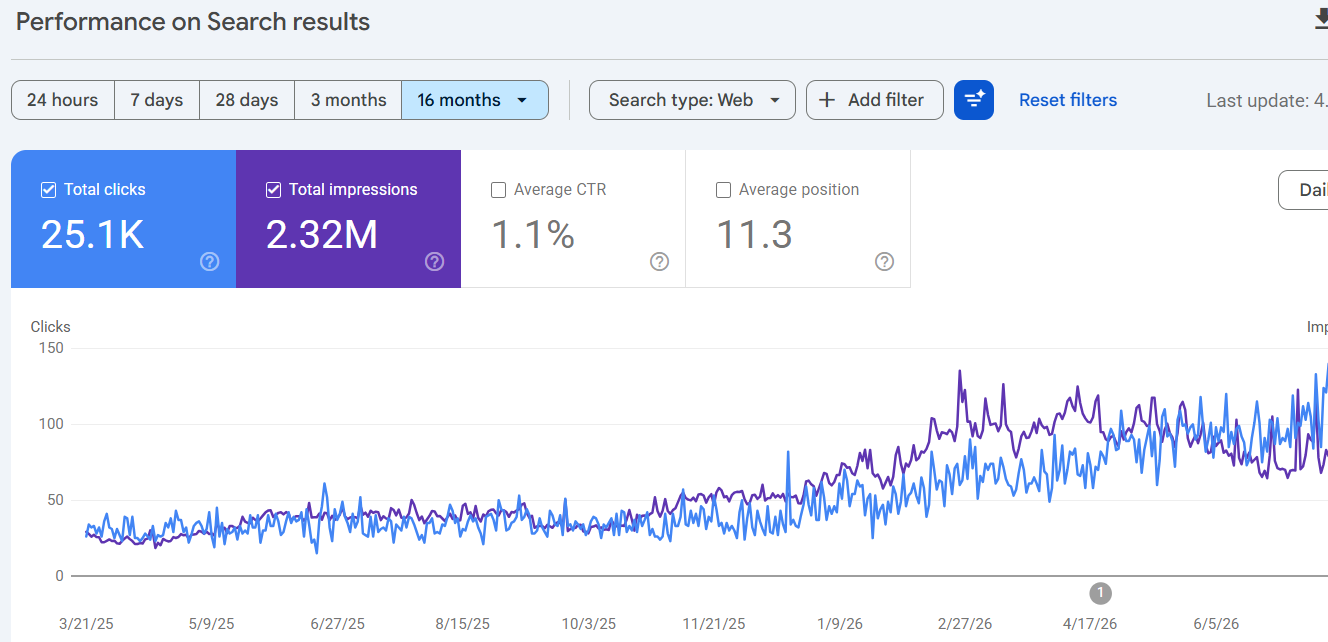
25.1K
Total clicks from Google Search
Google Search Console performance report showing 25.1K total clicks and 2.32M impressions across 16 months Search Console screenshot
Total impressions 2.32M
Average CTR 1.1%
Average position 11.3

2.32M impressions converted into 25.1K clicks at a 1.1% average CTR, with an average position of 11.3 across all tracked queries. Daily clicks and impressions both climbed from a flat baseline to sustained highs across the 16 month window.
Search Console · 16 months
Traffic & authority
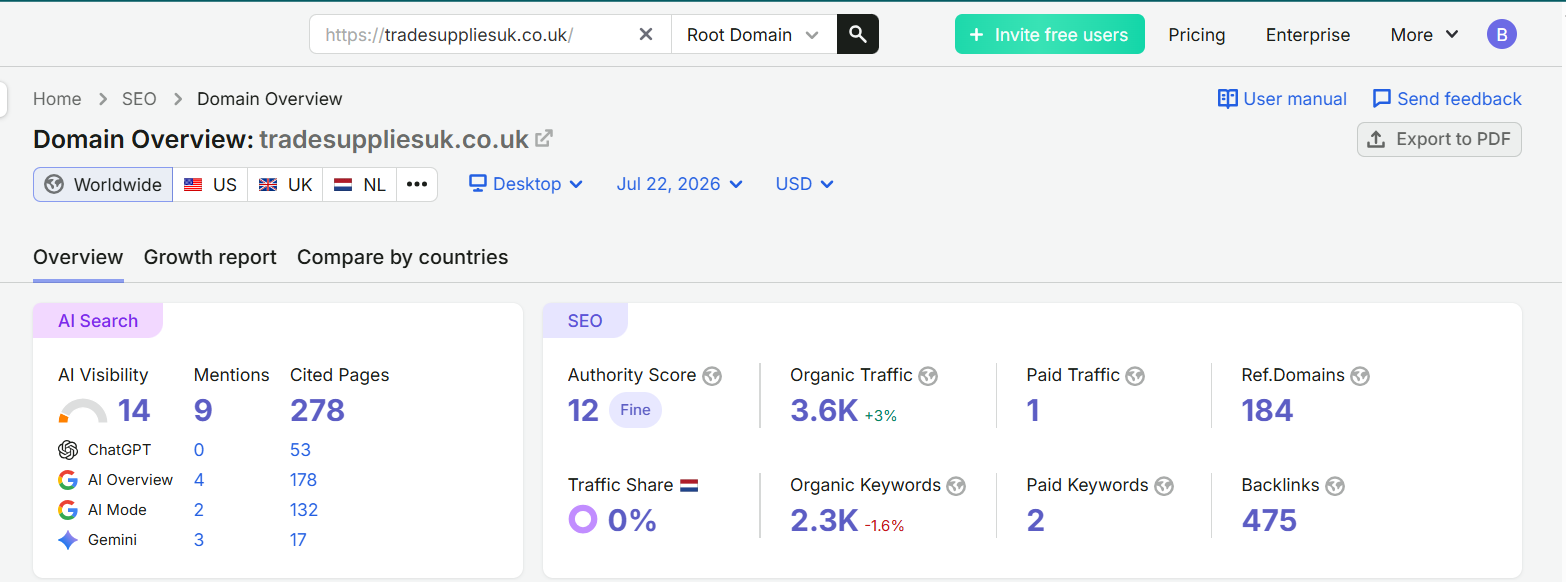
3.6K+3%
Monthly organic traffic
Semrush domain overview showing 3.6K organic traffic, 2.3K organic keywords, authority score 12, 184 referring domains and 475 backlinks Semrush screenshot
Organic keywords 2.3K
Authority score 12
Referring domains 184
Backlinks 475

3.6K monthly organic visits, up 3%, drawn from 2.3K ranking keywords. The profile is backed by 475 backlinks across 184 referring domains, with AI visibility at 278 cited pages and 9 mentions.
Semrush · Domain overview
Local SEO
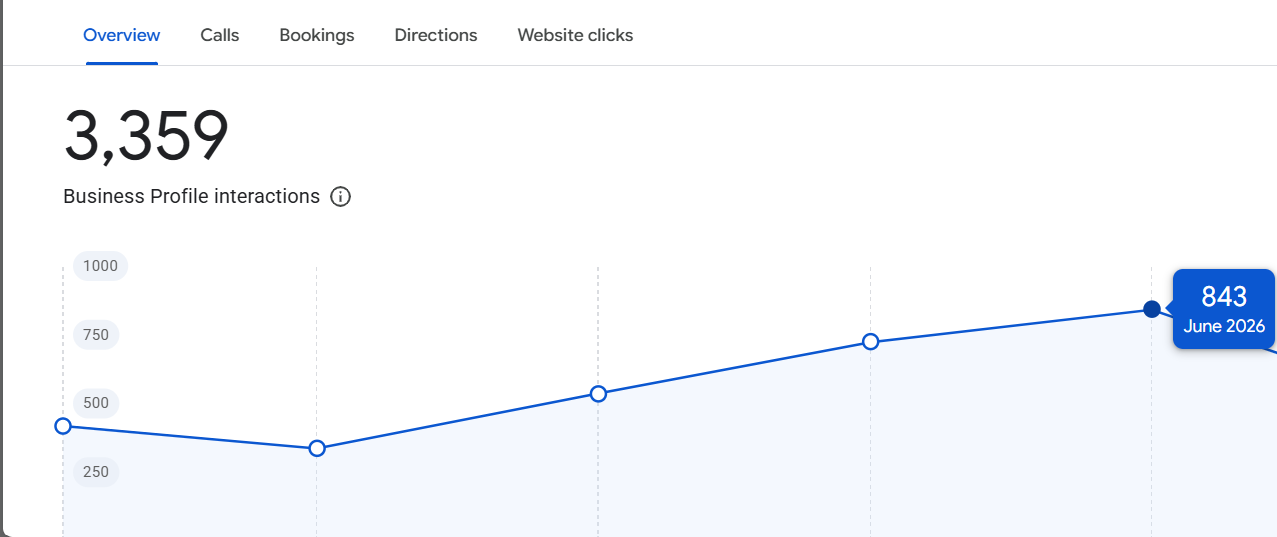
3,359
Business Profile interactions
Google Business Profile performance overview showing 3,359 total interactions rising to 843 in June 2026 Business Profile screenshot
Peak month 843
Starting month 462
Growth to peak +82%
Monthly average 560

3,359 Business Profile interactions across the period, climbing from 462 in the opening month to 843 by June 2026. Calls, bookings, direction requests and website clicks all trended upward together after the first quarter.

Business Profile · 6 months
Questions

Choosing a Shopify development company

Builds and customises the storefront: custom themes, reusable sections, storefront features, app integrations, performance work and multilingual setups, written in Liquid. The distinction worth asking about is whether an agency writes theme code or assembles stores from page builder apps, because the second approach costs you speed permanently.

We build rather than design. Most projects come to us with designs already, either from the client's designer or as a direction to work to. Where there are no designs we can work from an existing theme and customise it, but a full visual design project is a separate piece of work with a designer.

A theme customisation with several custom sections is usually two to four weeks. A full custom build runs six to ten. Migrations depend more on the catalogue and the redirect mapping than on the theme itself. We give a timeline at the scoping stage and flag early if anything is likely to move it.

Often, yes. Cart drawers, bundle builders, quick buy modals, sticky bars and countdown timers are all straightforward to build into a theme, and each one removed is a subscription saved and a script gone. Some apps are genuinely worth keeping, and we will say which.

Stop losing customers to page two.

Get a free audit of your current SEO and see exactly what is holding you back. No obligation, no pressure.

No lock-in contracts. Results reported every month.