Google Ads management agency paid on results
Google's own recommendations are built to increase your spend, not your return. We rebuild accounts around what actually converts, cut the queries quietly draining budget, and report against revenue rather than clicks or conversions Google decided to count.
- Search terms cleaned up before spend goes anywhere else
- Performance Max opened up rather than left as a black box
- Reporting that ends at revenue, not at a conversion count
Google Ads management services
Google Ads management is the ongoing work of structuring, running and optimising paid search campaigns against a commercial target, covering campaign architecture, keyword and search term control, bidding, creative testing and conversion tracking. The part most accounts are missing is not the setup. It is somebody checking, every week, what the money actually bought.
Site health score after technical fixes
Search campaigns that stop paying for junk
The search terms report is the most useful screen in Google Ads and the least frequently opened. It shows the actual queries your ads appeared for, as opposed to the keywords you chose. On most accounts we audit, a meaningful share of spend has gone to searches the business would never have bid on deliberately.
- Search terms reviewed weekly, not quarterly Broad match learns, and what it learns changes. A negative list built at setup and never revisited stops working within a couple of months. This is the single highest-return recurring task in an account and the one most often skipped.
- Match types chosen deliberately . Broad match works when there is enough conversion data to guide it and wastes money when there is not. New accounts usually need tighter control first, then room to widen once the signal exists.
- Structure that makes reporting readable Campaigns split so you can see which product, service or intent is earning its budget. An account with everything in one campaign cannot answer that question, and neither can its reports.
- Ad copy tested against each other, not against nothing Responsive search ads assemble themselves from your assets, so what matters is giving them assets worth assembling and pinning where the message cannot be allowed to vary.
Keywords ranking across the site
Ecommerce PPC services Shopping and PMax
For a retailer, Shopping and Performance Max usually carry most of the spend and almost all of the complexity. Performance Max in particular hands control to Google and returns very little visibility, which is fine when it is working and extremely difficult to diagnose when it is not. Most of the work is in what you feed it and what you exclude.
- The feed does the heavy lifting Titles, product types, attributes and images decide which searches you appear for. A Shopping campaign built on a feed straight out of the platform is competing with one built on a feed somebody actually worked on.
- Brand traffic separated out Performance Max will happily spend your budget on people searching your own brand name and report those as conversions. Separating brand from non-brand is usually the first change we make, and often the one that changes the numbers most.
- Asset groups split by intent One asset group covering the whole catalogue tells Google nothing about which products suit which audience. Splitting by category or margin gives it something to work with and gives you something to read.
- Exclusions doing the steering Since you cannot see much inside PMax, exclusions are the main control available. Search terms, placements and audiences all need pruning on a schedule rather than at setup.
Backlinks from 184 referring domains
PPC management services beyond the click
Paid search stops being useful the moment the reporting stops short of a sale. A campaign showing four hundred conversions at a good cost per acquisition means nothing if those conversions are newsletter signups. Getting the measurement right is not preparation for the work. It is most of it.
- Conversions that mean something Every action tracked, with a value attached where one exists, so the account optimises toward revenue rather than form fills. Where sales close offline, conversions get imported back so the bidding learns from what actually closed.
- Attribution understood, not argued over Google Ads, GA4 and your own back end will never agree exactly. We explain where the differences come from and pick one source as the number decisions are made against, rather than switching to whichever looks best that month.
- Landing pages treated as part of the campaign Sending paid traffic to a page that loads slowly or asks for eight fields is a spend problem, not a design problem. We flag it, and where it needs building we can build it.
- Room for other channels when they earn it Google carries the volume in most markets, which is why it is where we focus. Where a business has the budget and the audience for it, Microsoft Ads can extend reach at lower competition, and paid social covers demand that has not reached search yet. We will tell you when that is worth considering rather than selling it by default.
How our Google Ads agency runs an account
Paid search produces usable data faster than any other channel. Two to four weeks is normally enough to know whether the structure is right, which means there is no reason to wait a quarter before saying something honest about it.
- 01
Audit
We go through the account, the search terms report, the conversion setup and the landing pages. Most audits find spend going somewhere nobody intended, and the tracking disagreeing with the back end.
- 02
Rebuild
Structure, tracking and negatives fixed before budget increases anywhere. Adding spend to an account that is measuring the wrong thing makes the problem larger, not smaller.
- 03
Optimise weekly
Search terms, bids, budgets and creative reviewed every week against the targets agreed at the start. Weekly is not a service level, it is what broad match and Performance Max require to stay honest.
- 04
Report on revenue
Monthly reporting that ends at revenue and cost per acquisition, with the working shown underneath. If a campaign is not paying for itself we say so on that call rather than letting it run another quarter.
What the account data actually showed
Taken straight from a client account, unedited. Click through for the raw view.
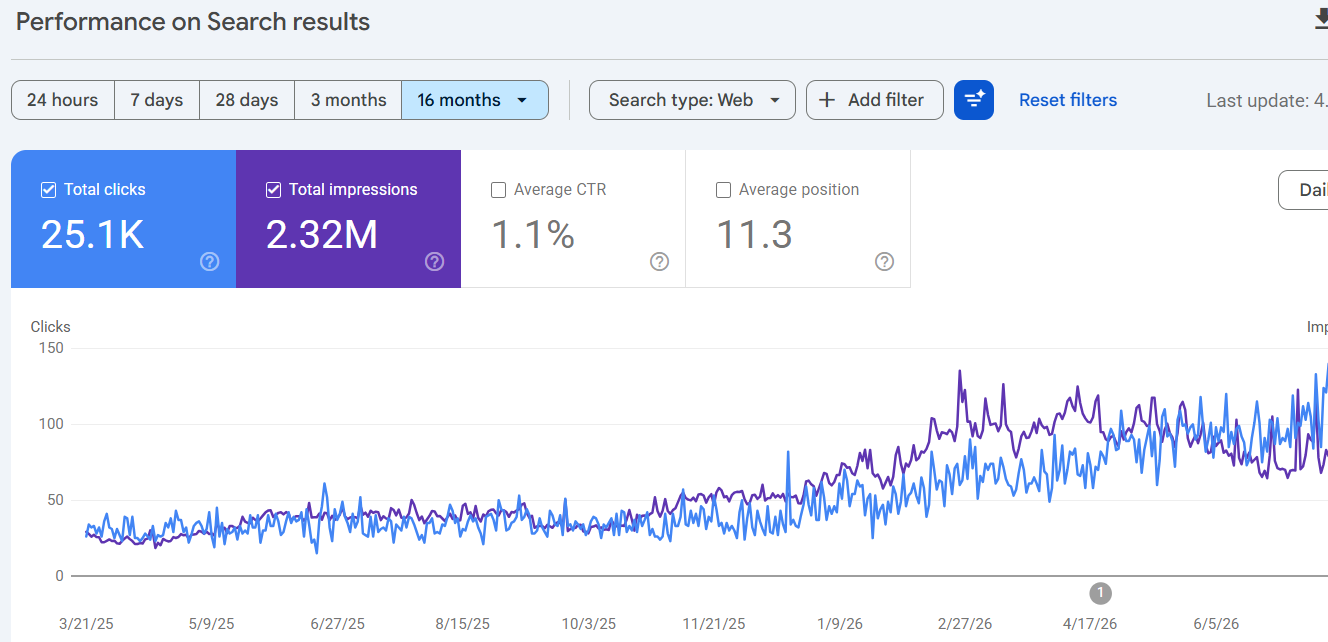 Search Console screenshot
15.8K impressions produced 1.06K clicks and 421.89 conversions from $1.52K in spend, working out at roughly $3.60 per conversion. More than one conversion came back for every three clicks delivered. This was a Performance Max rebuild on a UK client account that had been running for months without a clean search terms exclusion list, which is the most common thing we find on a PMax audit.
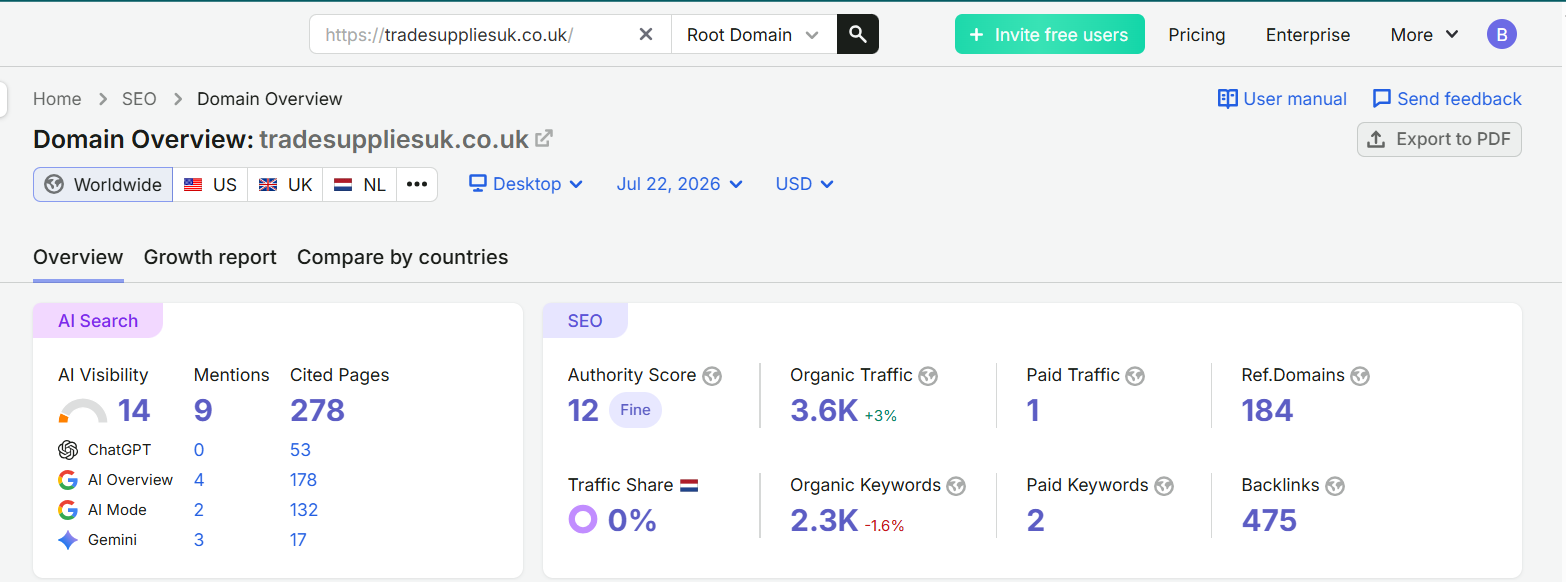 Semrush screenshot
3.6K monthly organic visits, up 3%, drawn from 2.3K ranking keywords. The profile is backed by 475 backlinks across 184 referring domains, with AI visibility at 278 cited pages and 9 mentions.
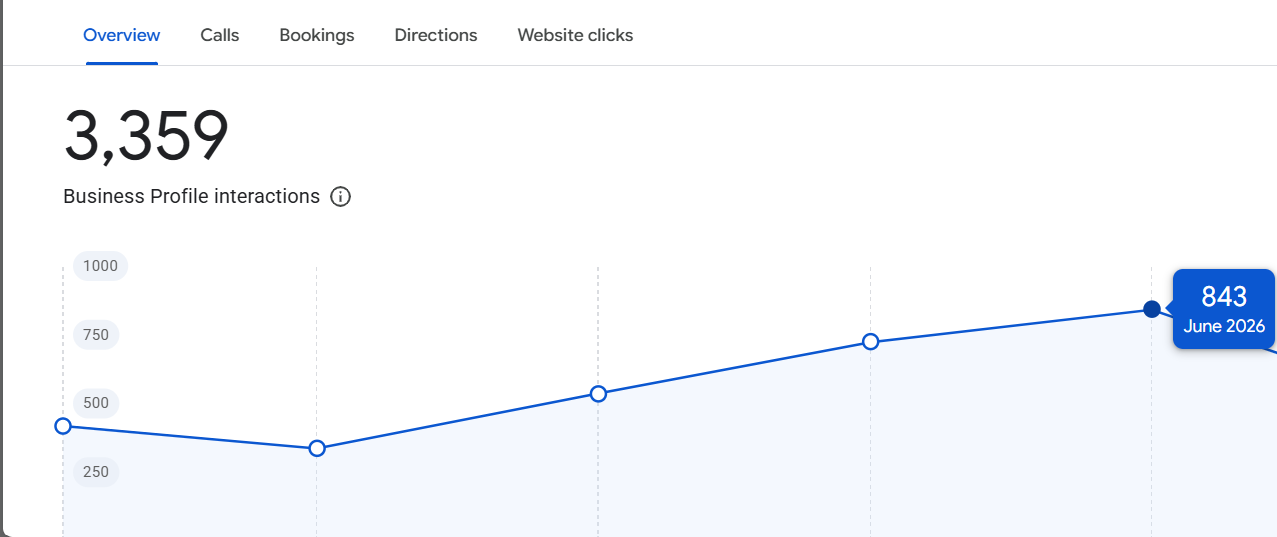 Business Profile screenshot
3,359 Business Profile interactions across the period, climbing from 462 in the opening month to 843 by June 2026. Calls, bookings, direction requests and website clicks all trended upward together after the first quarter.
Within five months our organic traffic had more than tripled, and we were finally showing up on page one for the keywords that actually bring in customers.
SMSarah MitchellOwner, home decor brandWe went from page three to the top of the map pack for our service area in under four months. Calls from search have roughly doubled since.
JCJames CarterOwner, local home services companyThe monthly reporting alone was worth it. For the first time we could see exactly which pages were driving revenue, not just traffic, with organic revenue up 61 percent year over year.
EWEmily WalshMarketing lead, skincare brand
Google Ads questions we get asked most
Structure and run the account, control what your ads appear for, set bidding and budgets, test creative, and make sure conversion tracking reflects real business outcomes. The ongoing part matters more than the setup. Broad match and Performance Max both change what they do over time, so an account left alone for a quarter is not the account you signed off.
Management fees typically run [X] to [Y] a month, or a percentage of ad spend on larger accounts. That is separate from the ad spend itself, which goes to Google. We quote after the audit, once we can see the account size and how much rebuilding is involved.
Enough for the account to gather data, which depends on your cost per click and how many conversions you need before automated bidding has something to learn from. In an expensive market, too small a budget produces no signal and no results. We will tell you during the audit if the budget is below the level where this works, rather than taking it anyway.
Usable data within two to four weeks, which is enough to know whether the structure and tracking are right. Meaningful performance improvement usually lands in the second month, once negatives have been applied and bidding has data to work from. Anyone promising results in week one is describing spend, not return.
Because that is largely how it is designed. It combines Search, Shopping, Display and YouTube inventory and reports very little about where the money went. The controls that do exist are the feed, asset groups, brand exclusions and search term exclusions. Most underperforming PMax campaigns we see have none of those set up.
Find out where your ad spend is going
Get a free account audit covering campaign structure, the search terms your budget is actually going to, conversion tracking accuracy, and what your Performance Max campaigns are hiding. Yours to keep either way.