Technical SEO services that fix what is blocking your pages
Your content is probably not the problem. We find what is stopping search engines from crawling, rendering and indexing your site, then fix it at source. Most sites we audit have pages Google has never seen, and no idea it is happening.
- Full crawl and index audit, with every issue ranked by impact
- Core Web Vitals fixed in the theme, not hidden behind a caching plugin
- Fixes implemented by us, not handed over as a PDF for someone else to action
Site health score after technical fixes
What a technical SEO audit covers, and in what order
A technical SEO audit is a systematic check of everything affecting whether search engines can crawl, render, index and rank your pages, covering six areas: crawling, indexing, Core Web Vitals, site architecture, rendering and structured data. We work through them in that order, because fixing schema on a page that is not being indexed achieves nothing. This is one part of our SEO services, and each area below feeds the next.
- Crawling Whether search engines can reach your pages at all, and whether they are wasting their time getting there.
- Core Web Vitals How the page loads and behaves for a real user on a real connection, measured on field data rather than a lab score.
- Site architecture How pages connect to each other, and whether authority is reaching the ones meant to rank.
- Rendering What search engines actually see, which on a JavaScript heavy site is often much less than what your browser shows.
Keywords ranking across the site
Crawling and indexing: unreachable pages cannot rank
The first thing we check on any site is how much of it Google has indexed against how much exists. On most sites the gap is larger than the owner expects, and it is rarely deliberate. Pages get excluded by a canonical pointing somewhere odd, a parameter creating hundreds of near duplicates, or a rule in robots.txt that made sense two rebuilds ago.
- Coverage read properly Search Console tells you which pages are excluded and gives a reason for each. Those reasons need interpreting rather than counting, because Discovered currently not indexed and Crawled currently not indexed point at completely different problems.
- Canonicals that agree with each other. Self referencing canonicals where they should be, cross domain ones where they are needed, and none of the loops that appear when a plugin and a theme both decide to write them.
- Crawl budget spent on the right URLs Redirect chains flattened, parameter URLs handled, and orphan pages either linked properly or removed. On a large site this is often the single change that moves the most.
- Sitemaps that reflect reality Only indexable, canonical, live URLs. A sitemap full of redirects and 404s teaches Google to trust it less, which slows down every page you publish afterwards.
Backlinks from 184 referring domains
Authority built through links you would be happy to name
Rankings for competitive terms come down to trust, and trust is earned through links from places that matter. We build slowly and editorially, because a profile that looks bought is a liability you pay for later.
- LCP dealt with at the element We identify which element is the largest contentful paint, then fix that specific thing. Usually it is a hero image served at the wrong size or a webfont blocking the render, and it is rarely solved by turning on more caching.
- Layout shift traced to its source Images without dimensions, injected banners, and late loading fonts each cause CLS in a different way and need different fixes. We find which one is happening on your pages rather than applying all three.
- Interaction delay measured on real devices INP reflects what happens when someone actually taps something. Heavy third party scripts are the usual cause, and the fix is often removing a tag nobody has looked at in a year.
- Field data over lab scores. A PageSpeed score is a simulation. Chrome UX Report data is what your users experienced. When those two disagree we go with the one based on real visits.
How our technical SEO agency works: audit, fix, monitor
Technical SEO is not a project that finishes. Sites change, themes update, and issues reappear. This is how we handle that on every account.
- 01
Audit
A full crawl alongside Search Console, log file and field performance data. Every issue found gets recorded with its likely impact and the effort needed to fix it.
- 02
Prioritise
Issues ranked by what will move rankings soonest, not by what is quickest to tick off. Some things flagged red by a crawler genuinely do not matter, and we say so rather than billing to fix them.
- 03
Implement
We make the changes ourselves, in the theme and the templates. You are not handed a hundred page PDF and left to find a developer who understands it.
- 04
Verify and monitor
Every fix is confirmed in Search Console and field data rather than marked complete on trust. Then the site is monitored monthly, because the next theme update will undo something.
What the fixes looked like in the data
Screenshots taken straight from client reporting. Click any of them to see the raw view.
 Search Console screenshot
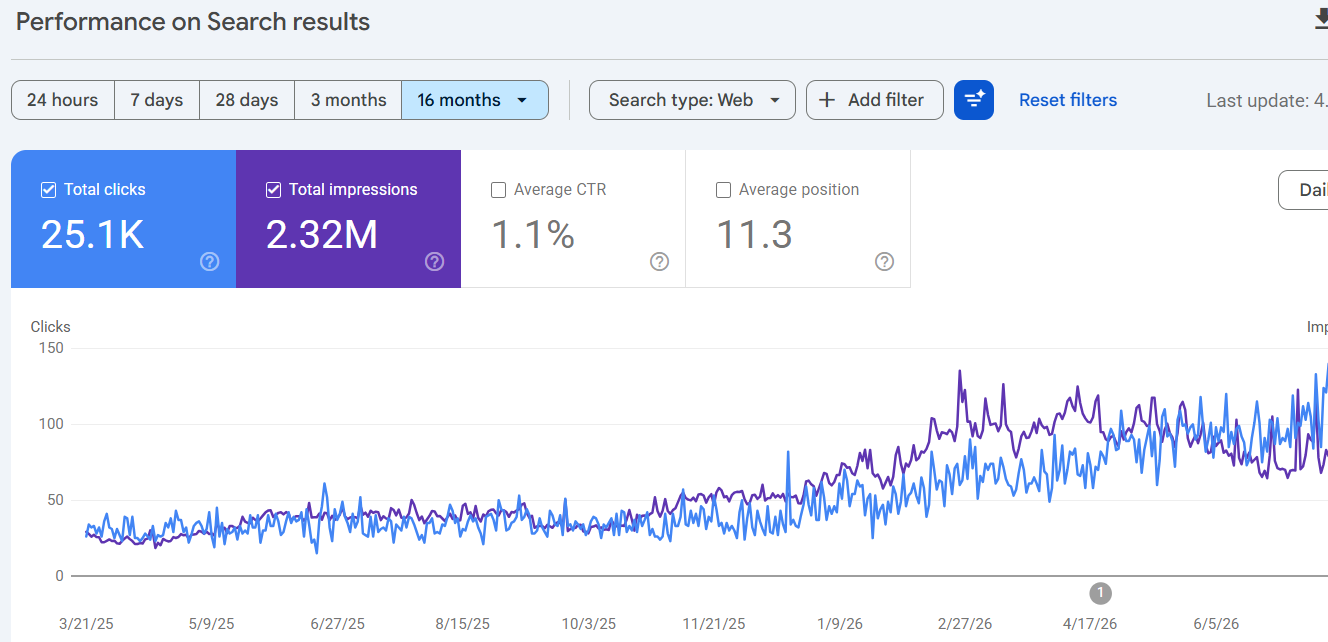
2.32M impressions converted into 25.1K clicks at a 1.1% average CTR, with an average position of 11.3 across all tracked queries. Daily clicks and impressions both climbed from a flat baseline to sustained highs across the 16 month window.
 Semrush screenshot
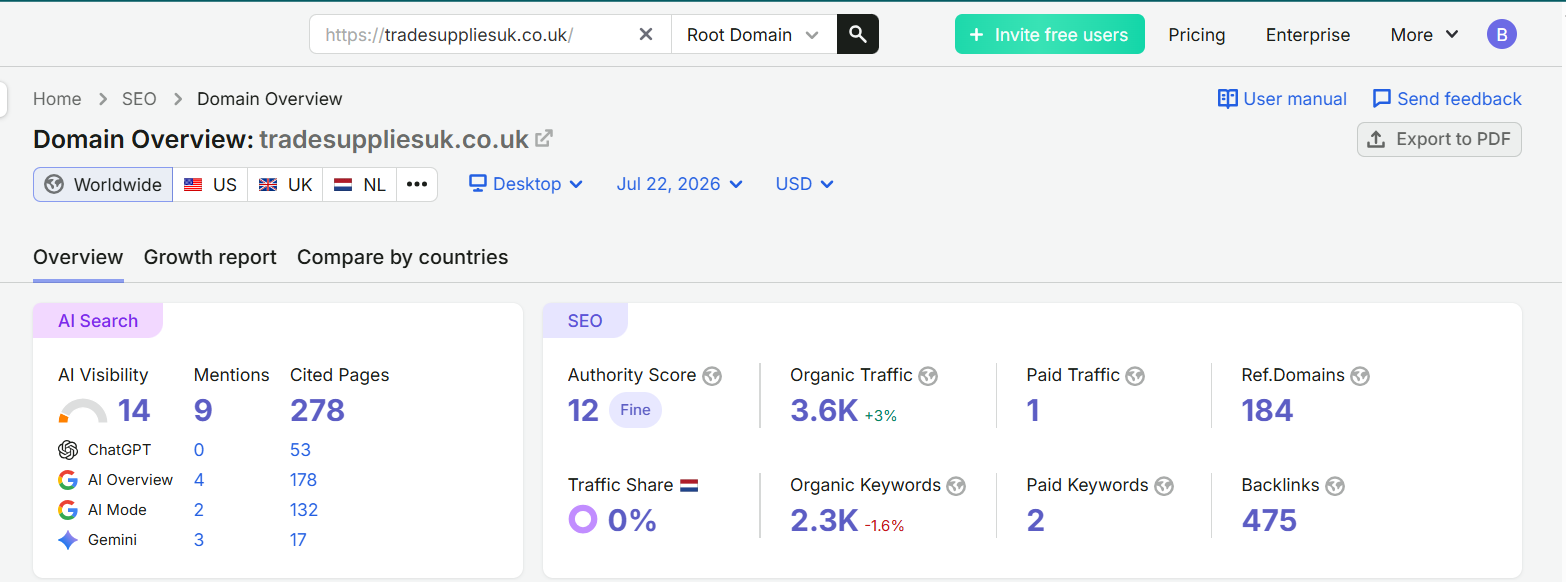
3.6K monthly organic visits, up 3%, drawn from 2.3K ranking keywords. The profile is backed by 475 backlinks across 184 referring domains, with AI visibility at 278 cited pages and 9 mentions.
 Business Profile screenshot
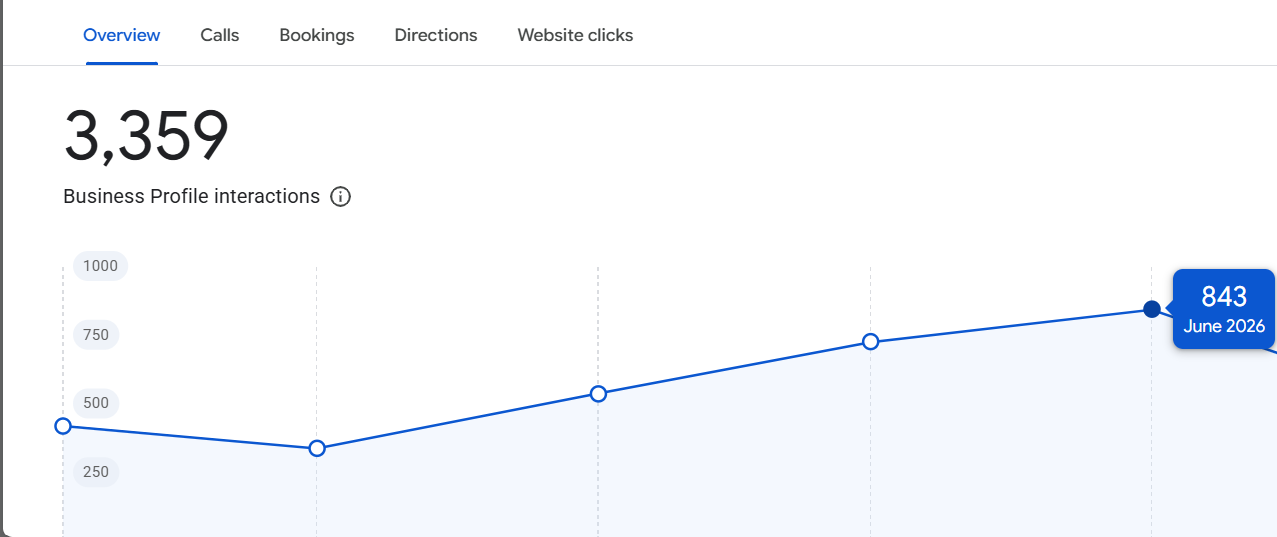
3,359 Business Profile interactions across the period, climbing from 462 in the opening month to 843 by June 2026. Calls, bookings, direction requests and website clicks all trended upward together after the first quarter.
Within five months our organic traffic had more than tripled, and we were finally showing up on page one for the keywords that actually bring in customers.
SMSarah MitchellOwner, home decor brandWe went from page three to the top of the map pack for our service area in under four months. Calls from search have roughly doubled since.
JCJames CarterOwner, local home services companyThe monthly reporting alone was worth it. For the first time we could see exactly which pages were driving revenue, not just traffic, with organic revenue up 61 percent year over year.
EWEmily WalshMarketing lead, skincare brand
Frequently asked questions
Technical SEO covers everything affecting whether search engines can find, load, render and index your pages. It comes first because the rest of SEO depends on it. Content cannot rank on a page that is not indexed, and links pointing at a page that loads in eight seconds are working against a handicap.
A general website audit usually covers design, usability and conversion alongside search. A technical SEO audit looks only at what affects search engine access and performance: crawling, indexing, speed, rendering, architecture and markup. We can cover the wider ground too, but they are separate pieces of work with different outputs.
We fix them. A technical audit delivered as a PDF is only useful if someone implements it, and in practice most of them sit unopened. We make the changes in the theme and templates, and confirm each one in the data afterwards.
Usually one to two weeks depending on site size, longer for large ecommerce catalogues where log file analysis is involved. Implementation runs from a few days on a small site to a couple of months where template level changes are needed.
Yes. We work across WordPress, Shopify, Webflow and custom builds. The constraints differ, and on some platforms certain fixes need working around rather than implementing directly, but the audit and the priorities are the same.
Find out what your site is hiding
Get a free technical audit covering crawl and index coverage, Core Web Vitals and site architecture. You get the findings and the priority order, whether or not we do the work.