AI SEO agency for brands that want to be cited
A growing share of searches now end in an answer rather than a click. If that answer does not mention you, the ranking underneath it is worth less than it was. We work on getting your pages cited as the source AI engines pull from, across AI Overviews, ChatGPT, Perplexity and Gemini.
- Structured so AI engines can extract a clean answer from your pages
- Entity and schema work that makes your brand recognisable as a source
- Citation tracking, so you know where you appear and where you do not
Site health score after technical fixes
GEO agency or AEO services the same work
GEO stands for Generative Engine Optimization. AEO stands for Answer Engine Optimization. AI SEO is the broader term for both. In practice all three describe the same work: making your content the thing an AI engine quotes when it answers a question. Different agencies picked different names, and the industry has not settled on one.
- If you are looking for a GEO agency this is that service. Generative Engine Optimization is the term borrowed from the original academic paper on the subject, and it is the one most commonly used for optimising toward generative answers specifically.
- If you are comparing AEO services the same applies. Answer Engine Optimization tends to be used more broadly, covering featured snippets and voice assistants alongside AI chat, which is where the term originally came from.
- The distinction that does matter is not which acronym an agency uses. It is whether they can show you where you are currently cited and where you are not. Most cannot, because they are not tracking it.
- Schema that earns features. Product, FAQ and article markup implemented and validated, not pasted in and left to break on the next theme update.
Keywords ranking across the site
Getting cited how AI engines pick their sources
AI engines do not rank pages. They assemble an answer and pick a handful of sources to credit. Those sources are drawn largely from pages already ranking well, then filtered by which ones state something clearly enough to quote. That second filter is where most sites lose out, and it is the part nobody is working on.
- Conventional rankings still matter AI engines pull from search results before deciding what to cite. A page nobody ranks for is not a candidate. This is why AI SEO sits on top of technical and on-page work rather than replacing it, and why anyone selling it as a standalone replacement is overselling.
- Entities recognised, not just mentioned Your business needs to exist as a known entity, connected to consistent information across the web. Organization schema, matching profiles and consistent naming are what let an engine attribute a statement to you by name.
- Claims that can be attributed Engines prefer sources that state something specific and verifiable. Original data, named authors and dated content get cited more often than the same information written anonymously and undated.
- Access granted deliberately Some sites block AI crawlers by default and have never checked. Others allow everything without deciding to. Either way it is worth being a decision rather than an accident, because it determines whether any of the rest applies.
Backlinks from 184 referring domains
Content built to be extracted, not just read
An engine assembling an answer needs to lift a complete, self-contained statement from somewhere. Content written as a flowing argument, where the point only makes sense after three paragraphs of build-up, gives it nothing to take. The fix is structural rather than stylistic, and it improves the page for human readers at the same time.
- A definition sentence after every heading One complete sentence that answers the heading before any elaboration. This is the single highest-return change on most pages, and it is why the sections on this page are written the way they are.
- Headings phrased as questions AI prompts are longer and more conversational than search queries. Headings matching how someone would actually ask give an engine a clearer signal about what the section answers.
- Self-contained blocks Each section should make sense lifted out of the page. Content that depends on what came before it cannot be quoted without the rest of the article coming along.
- Schema that confirms the structure FAQPage, Article and HowTo markup describing what is on the page in a format that does not depend on interpreting the writing. It costs little and removes ambiguity.
A clear path from audit to rankings.
No black box reporting. You will know exactly what we are doing and why, every step of the way.
- 01
Audit
We crawl your site, review your niche, and map exactly where you are losing visibility today.
- 02
Strategy
A prioritized roadmap: technical fixes, content targets, and link opportunities, ranked by impact.
- 03
Execution
Our team implements the roadmap on-site, on-page, and off-site, while you run your business.
- 04
Reporting
Monthly reporting on rankings, traffic, and revenue impact, plus a call to plan what is next.
Every claim here comes with the dashboard behind it
Search visibility, domain authority and local presence, pulled straight from the reporting we send clients each month. Click any screenshot to see the raw data for yourself.
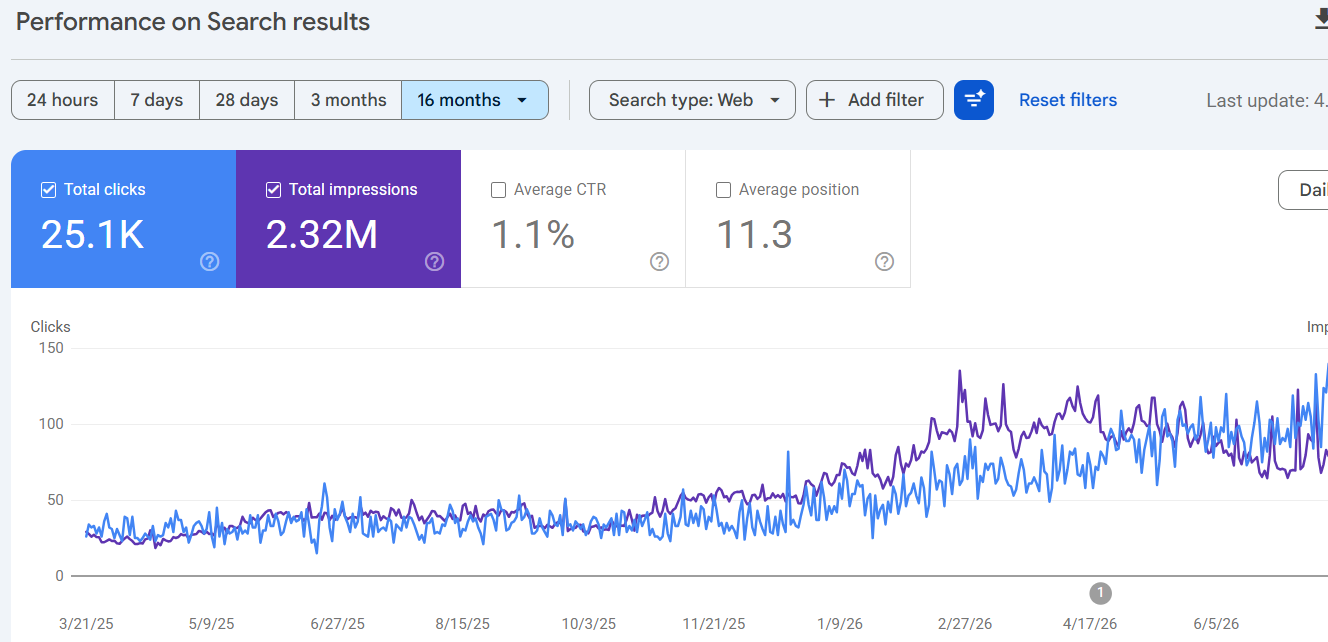 Search Console screenshot
2.32M impressions converted into 25.1K clicks at a 1.1% average CTR, with an average position of 11.3 across all tracked queries. Daily clicks and impressions both climbed from a flat baseline to sustained highs across the 16 month window.
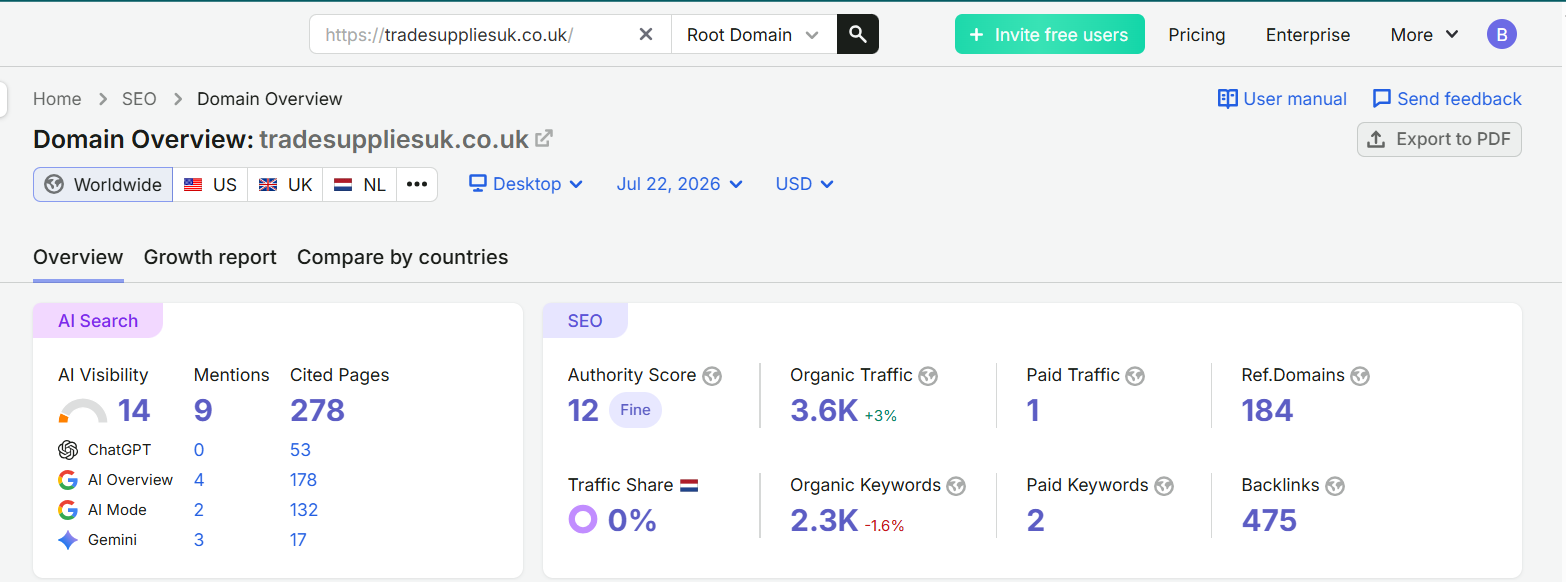 Semrush screenshot
3.6K monthly organic visits, up 3%, drawn from 2.3K ranking keywords. The profile is backed by 475 backlinks across 184 referring domains, with AI visibility at 278 cited pages and 9 mentions.
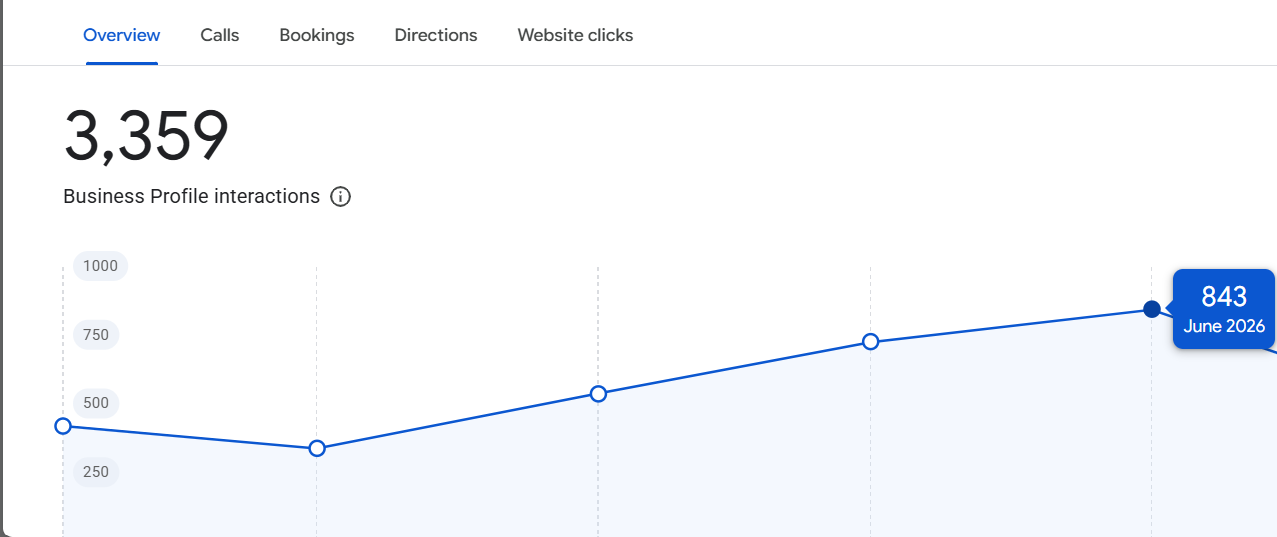 Business Profile screenshot
3,359 Business Profile interactions across the period, climbing from 462 in the opening month to 843 by June 2026. Calls, bookings, direction requests and website clicks all trended upward together after the first quarter.
Within five months our organic traffic had more than tripled, and we were finally showing up on page one for the keywords that actually bring in customers.
SMSarah MitchellOwner, home decor brandWe went from page three to the top of the map pack for our service area in under four months. Calls from search have roughly doubled since.
JCJames CarterOwner, local home services companyThe monthly reporting alone was worth it. For the first time we could see exactly which pages were driving revenue, not just traffic, with organic revenue up 61 percent year over year.
EWEmily WalshMarketing lead, skincare brand
Find out if AI engines are citing you
Get a free AI visibility audit. We run a set of prompts your buyers would actually ask across four platforms, record where you appear, where competitors appear instead, and which pages are structured well enough to be quoted. Yours to keep either way.
Frequently asked questions
AI SEO is the work of getting your content cited as a source inside AI-generated answers, across AI Overviews, ChatGPT, Perplexity and Gemini. It covers content structure, entity markup, source credibility and crawler access. It runs alongside conventional SEO rather than replacing it, because AI engines mostly draw their sources from pages that already rank.
Very little in practice. GEO stands for Generative Engine Optimization, AEO for Answer Engine Optimization, and AI SEO is the broader term. All three describe making your content the thing an AI engine quotes. Different agencies adopted different names and the industry has not settled on one. What matters is whether the agency can show you where you are cited today.
No, and be careful with anyone who says it does. AI engines pull their sources from search results, so a page that does not rank is not in the running to be cited. Technical health, on-page work and links still do the heavy lifting. AI SEO is the layer that decides whether the pages already ranking get quoted.
That is a real decision with arguments on both sides. Blocking protects content from being used without attribution, but also removes any chance of being cited as a source. Publishers with paid content often block. Businesses trying to be found usually should not. Either way it should be a decision rather than a default nobody checked.
Structural changes to existing pages can show up in citations within weeks, because engines re-read pages they already know. Entity and credibility work takes longer, usually a few months, since it depends on signals accumulating across the web rather than on one site.