On-page SEO services that make every page count
Most sites have pages that almost rank. They sit on page two, target a keyword three other pages are also chasing, or answer a question nobody is asking. We map every page to one keyword and one job, then rebuild the page around it.
- Every page mapped to a single keyword and a clear intent
- Titles, headings and metadata rewritten to earn the click
- Internal links and anchors that push authority where it counts
Site health score after technical fixes
Keyword mapping one page, one target
Before a single title tag gets rewritten, every page needs a keyword it owns and no other page is chasing. This is the step most sites skip, and it is why a site with plenty of content still ranks for none of it. Three of your pages competing for the same term is not three chances to rank. It is Google picking one at random and ignoring the rest.
- Intent checked against the live SERP Volume and difficulty scores are a starting point, not the answer. We look at what is actually ranking, because a service page will not win a query the results are answering with guides, whatever the tool says.
- Cannibalisation found and resolved We map every existing URL to the terms it currently ranks for, then find the overlaps. Some pages get retargeted, some get merged, and some get redirected into the page that was always going to win.
- Commercial value weighted properly A keyword with 9K searches and no buying intent is worth less than one with 400 and a credit card behind it. We say which is which before the work starts, not after.
- Gaps mapped to new pages Where competitors rank for terms you have no page for, that becomes a brief rather than a note in a report nobody reads.
Keywords ranking across the site
Page structure and metadata that earn the click
Ranking is only half of it. A listing at position three that nobody clicks earns less than one at position five that reads like the answer. We write titles and headings to do both jobs at once, and structure the page so search engines can lift a clean answer out of it.
- Titles written for the click, not just the crawler Keyword near the front, under sixty characters so it does not truncate, and a reason to choose your listing over the four around it. Most title tags fail on that last part.
- Headings that carry the structure One H1, no skipped levels, and each H2 naming what its section covers. Headings chosen for font size rather than meaning are the most common problem we find in page builders.
- Answer-first paragraphs The sentence directly after each heading answers it, before any build-up. That is the shape featured snippets and AI Overviews extract, and it is the cheapest visibility available right now.
- Metadata that is not left to chance. Every page gets a written meta description. Left blank, Google writes its own from whatever text it finds, and it is rarely the sentence you would have chosen.
Backlinks from 184 referring domains
Content depth and links that build relevance
Once a page is targeted and structured, what is left is whether it covers the subject properly and whether the rest of the site backs it up. Depth is not word count. It is whether the page uses the vocabulary of the topic and answers the questions that come after the main one.
- Entity coverage, not keyword density Search engines understand topics through the concepts that appear around them. A page about paid search that never mentions CPC, quality score or match types reads as thin, whatever its word count.
- Questions answered on the page The related searches and People Also Ask boxes are a free brief. Pages that answer them tend to hold rankings longer, because visitors stop bouncing back to the results.
- Anchor text that names the destination Explore more and click here tell search engines nothing. Anchors carrying the target page's keyword are one of the strongest signals you fully control, and most sites waste them.
- Authority routed deliberately Your strongest pages should link to the ones that need help. On most sites they link to the contact page and the blog index instead.
How our on-page SEO agency works
On-page work runs page by page in priority order, starting with the ones closest to moving. Pages sitting at the bottom of page one usually return faster than anything else on the site.
- 01
Map
Every URL matched to the terms it currently ranks for, with overlaps and gaps recorded. This is where cannibalisation shows up, and it is often the largest single problem on the site.
- 02
Prioritise
Pages ranked by how close they are to a meaningful position and how much traffic sits behind the term. Positions eight to fifteen come first, because that is where small changes show up quickest.
- 03
Rewrite
Titles, headings, metadata, body content and internal links reworked page by page. We implement the changes rather than sending recommendations for someone else to action.
- 04
Measure
Each page tracked against its own baseline in Search Console. Changes that do not move anything after a fair window get revisited rather than quietly left in place.
Every claim here comes with the dashboard behind it
Search visibility, domain authority and local presence, pulled straight from the reporting we send clients each month. Click any screenshot to see the raw data for yourself.
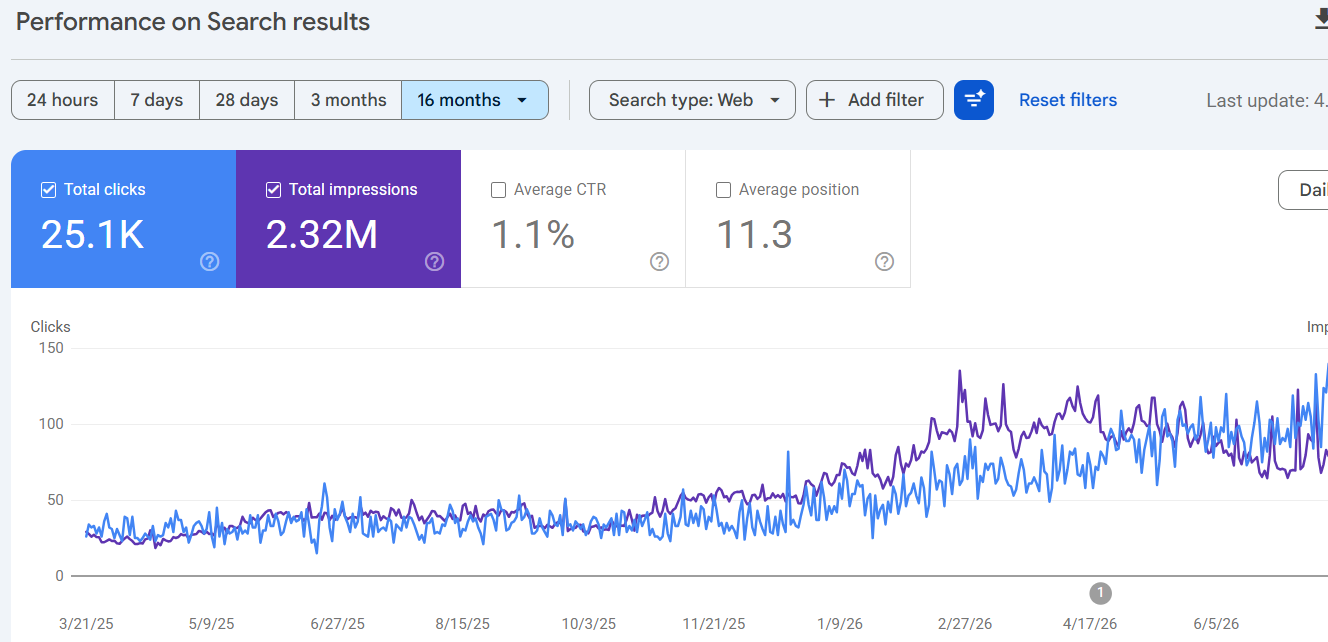 Search Console screenshot
2.32M impressions converted into 25.1K clicks at a 1.1% average CTR, with an average position of 11.3 across all tracked queries. Daily clicks and impressions both climbed from a flat baseline to sustained highs across the 16 month window.
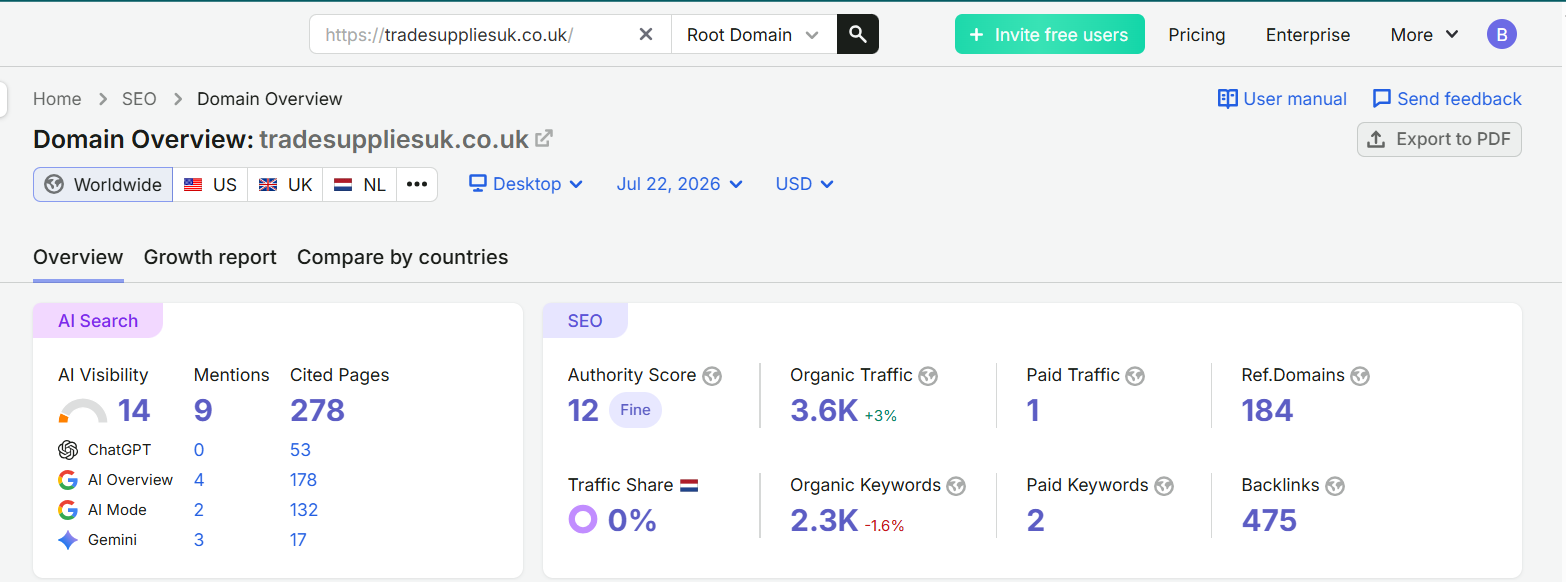 Semrush screenshot
3.6K monthly organic visits, up 3%, drawn from 2.3K ranking keywords. The profile is backed by 475 backlinks across 184 referring domains, with AI visibility at 278 cited pages and 9 mentions.
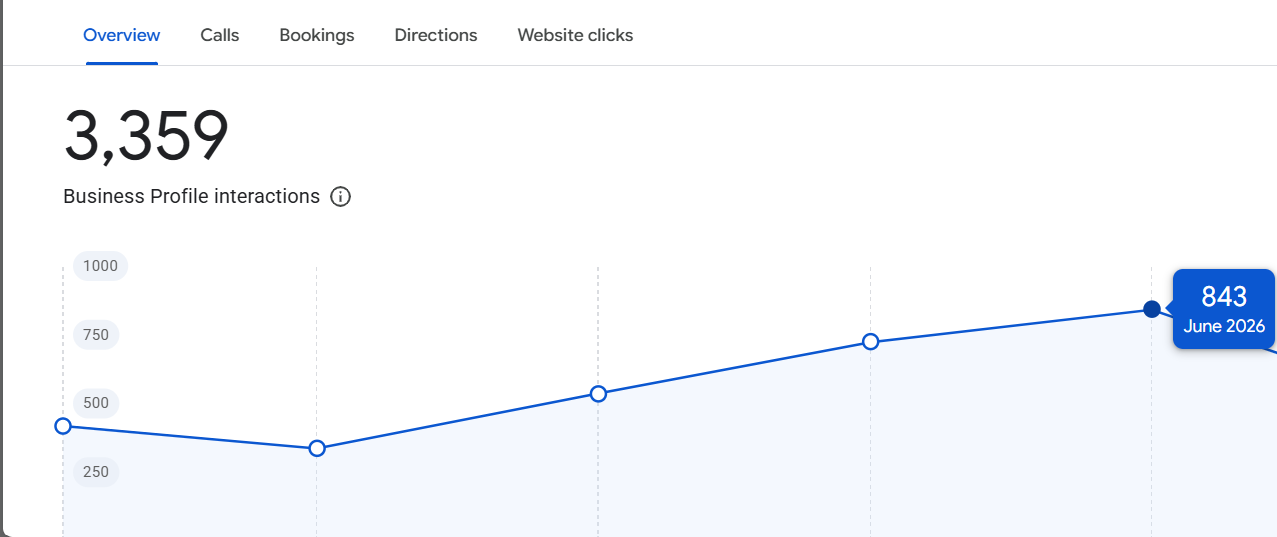 Business Profile screenshot
3,359 Business Profile interactions across the period, climbing from 462 in the opening month to 843 by June 2026. Calls, bookings, direction requests and website clicks all trended upward together after the first quarter.
Within five months our organic traffic had more than tripled, and we were finally showing up on page one for the keywords that actually bring in customers.
SMSarah MitchellOwner, home decor brandWe went from page three to the top of the map pack for our service area in under four months. Calls from search have roughly doubled since.
JCJames CarterOwner, local home services companyThe monthly reporting alone was worth it. For the first time we could see exactly which pages were driving revenue, not just traffic, with organic revenue up 61 percent year over year.
EWEmily WalshMarketing lead, skincare brand
On-page SEO questions we get asked most
On-page SEO is everything done on a page itself to help it rank and get clicked: keyword targeting, title tags, meta descriptions, heading structure, content, internal links and image optimisation. It sits between technical SEO, which is about whether search engines can reach the page, and off-page SEO, which is about links pointing at it from elsewhere.
Technical SEO deals with whether a search engine can crawl, render and index your pages at all. On-page SEO deals with whether the page it reached is worth ranking. Speed, canonicals and crawl budget are technical. Titles, headings, keyword mapping and internal links are on-page. Most sites need both, and technical comes first because nothing else works without it.
Faster than most SEO work. Pages already indexed and ranking somewhere on page one or two often move within two to six weeks of being re-optimised, because Google is only re-evaluating a page it already knows. Pages starting from nowhere take longer, and usually need more than on-page work to get there.
A lot of it, yes, and the checklist above is genuinely the order to work in. Where it gets difficult is keyword mapping across a whole site, because that needs a view of what every page currently ranks for and what your competitors own. That is the part clients most often bring us in for after trying it internally.
It is when two or more of your pages target the same keyword, so they compete with each other. Google picks one and largely ignores the others, and it does not always pick the one you would have. On sites with a few years of blog content it is one of the most common problems we find, and fixing it often lifts rankings without any new content at all.
Find out which pages are underperforming
Get a free on-page audit covering keyword mapping, cannibalisation conflicts, title and heading issues, and the pages closest to moving. Yours to keep either way.