
Ecommerce SEO agency for stores that sell
Most stores put their SEO effort into product pages and blog posts, while the pages that actually rank for buying searches sit half-built. Collection pages are where ecommerce organic traffic comes from, and on most stores they are a title, a grid and nothing else.
- Collection pages built to rank, not just to list products
- Product templates and schema that scale across the whole catalogue
- Faceted navigation handled before it eats your crawl budget
Site health score after technical fixes
Collection pages where the traffic actually is
Someone searching to buy types a category, not a product name. They search for running shoes, not for the exact model they have never heard of. That search lands on a collection page, which means collection pages carry the buying-intent traffic on almost every store. They are also the pages most likely to be a heading, a product grid and nothing else.
- Copy that earns the ranking A collection page with no text is asking to rank on the product names inside it. A few hundred words covering what the category includes, how to choose and what the differences are gives the page something to rank on, placed so it does not push the grid below the fold.
- One collection per search, not per merchandising idea Stores accumulate collections built for a campaign or a homepage banner, and several end up targeting the same search. Merging or redirecting those often lifts the survivor without any new content at all.
- Pagination that does not lose products On a long collection, products on page six may never be crawled. Whether the answer is pagination, load more or a flatter structure depends on the platform, but leaving it to the theme default rarely works.
- Linked from somewhere that matters Collections buried three menus deep get treated as unimportant. This is also where a retail SEO agency brief usually differs from a pure ecommerce one, because in-store ranges and online collections are not always the same thing and the site structure has to pick one.
Keywords ranking across the site
Product pages at scale without duplication
Nobody hand-writes four thousand product pages. Ecommerce SEO at the product level is a template problem: what the title pattern is, what schema every page outputs, how variants are handled, and what happens to the manufacturer description that fifty other retailers are also using.
- Title patterns that scale A template producing brand, product, key attribute is worth more than one producing product name alone, across the whole catalogue. Get the pattern right once and every page benefits, including the ones added next year.
- Descriptions that are yours Supplier copy appears identically across every retailer selling that item, so none of them stand out. Rewriting the top sellers and templating the long tail is usually the practical balance, rather than pretending all four thousand will be rewritten.
- Product schema, complete and valid Price, availability, reviews and identifiers, output correctly so listings can show rich results. This breaks after theme and app updates more often than anything else on a store, so it needs checking rather than setting once.
- Variants that do not fragment Size and colour variants can create a separate crawlable URL each, splitting signals across pages that are the same product. Canonicalising them to one page consolidates that back.
Backlinks from 184 referring domains
Faceted navigation and crawl control
Every filter combination a shopper can click is a URL a crawler can follow. Colour, size, price and brand together produce thousands of near-identical pages on a mid-sized store. Left alone, crawlers spend their time there instead of on the product pages you wanted indexed, and the store's real pages get visited less often.
- Find out what is actually being crawled Log files and the coverage report show where crawl budget is going. On large stores this usually reveals a filter combination consuming a disproportionate share, and it is rarely one anyone expected.
- Decide which facets deserve to rank Some filtered views are worth indexing because people search them, such as a brand within a category. Most are not. The decision is per facet, and getting it right turns a liability into extra landing pages.
- Implement it in a way the platform supports Shopify, WooCommerce and Magento each handle parameters differently, and some fixes that work on one are not available on another. We work within what the platform allows rather than recommending something that cannot be built.
- Check it again after every app install Filter and search apps frequently reintroduce crawlable parameters that were previously handled. On a store with an active development cycle this needs monitoring, not a one-off fix.
How we work on an ecommerce store
Store SEO runs template first, page second. Fixing one collection page teaches you what to change. Changing the template applies it to four hundred.
- 01
Crawl and audit
A full crawl of the store alongside Search Console and, on larger catalogues, log files. This is where duplicate collections, orphaned products and runaway filter URLs show up.
- 02
Fix the templates
Title patterns, schema output, canonicals and internal linking changed at template level so every page in the catalogue picks up the improvement, including the ones added later.
- 03
Build the collections
The collection pages carrying real search demand get proper copy, structure and internal links, worked through in priority order rather than all at once.
- 04
Measure by page type
Reporting split by collections, products and content rather than one site-wide traffic line, because those three move at different speeds and a single number hides which one is working.
Every claim here comes with the dashboard behind it
Search visibility, domain authority and local presence, pulled straight from the reporting we send clients each month. Click any screenshot to see the raw data for yourself.
 Search Console screenshot
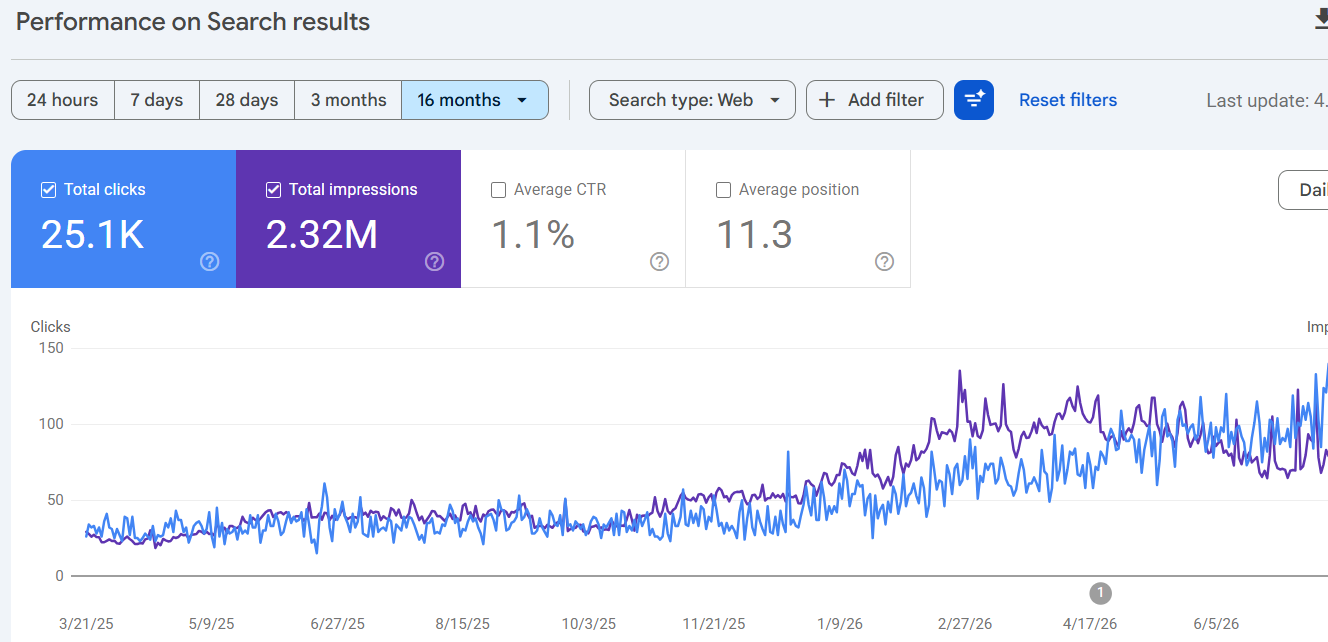
2.32M impressions converted into 25.1K clicks at a 1.1% average CTR, with an average position of 11.3 across all tracked queries. Daily clicks and impressions both climbed from a flat baseline to sustained highs across the 16 month window.
 Semrush screenshot
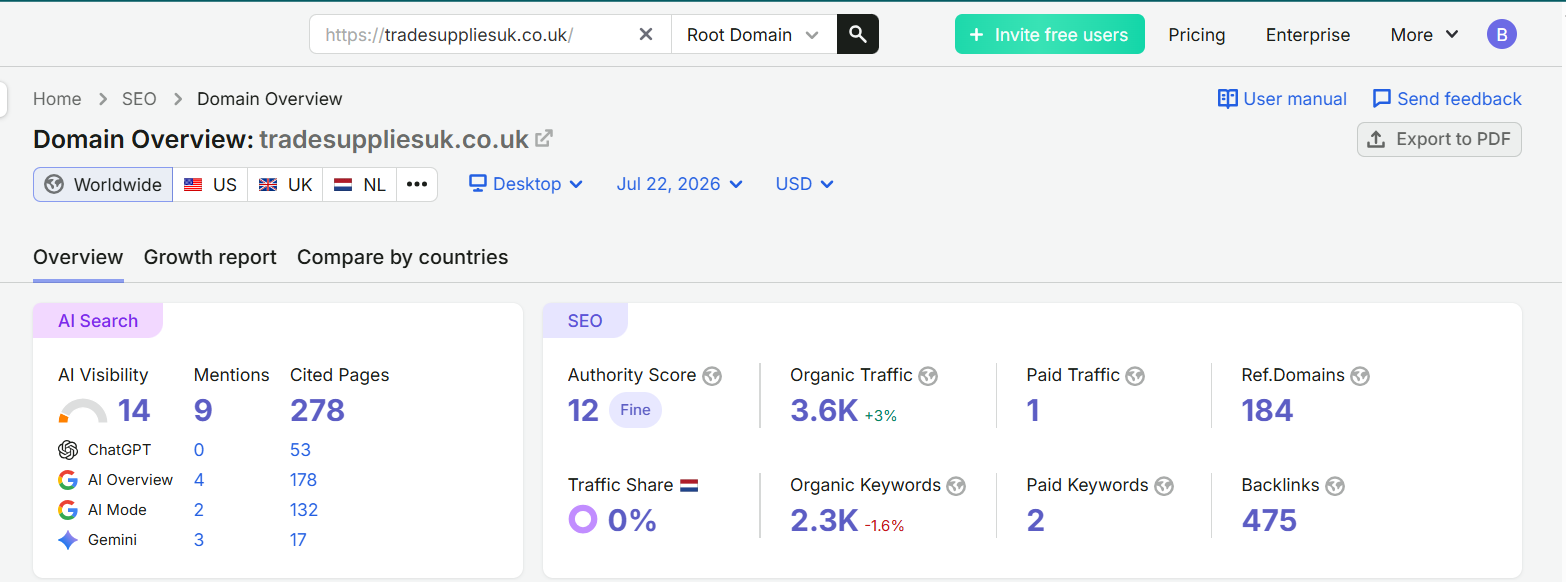
3.6K monthly organic visits, up 3%, drawn from 2.3K ranking keywords. The profile is backed by 475 backlinks across 184 referring domains, with AI visibility at 278 cited pages and 9 mentions.
 Business Profile screenshot
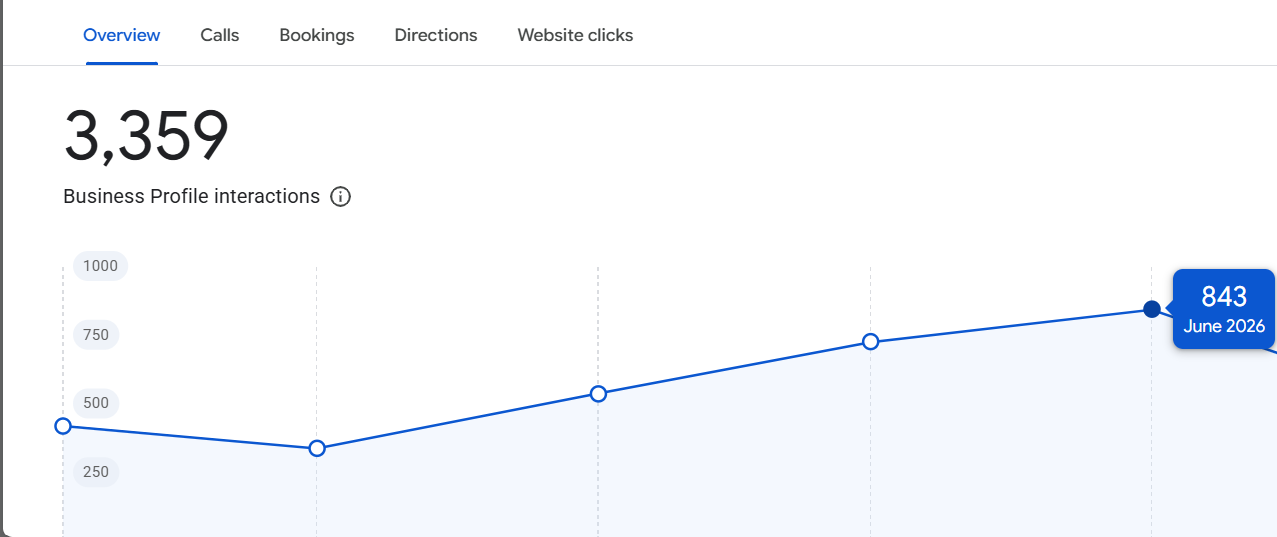
3,359 Business Profile interactions across the period, climbing from 462 in the opening month to 843 by June 2026. Calls, bookings, direction requests and website clicks all trended upward together after the first quarter.
Within five months our organic traffic had more than tripled, and we were finally showing up on page one for the keywords that actually bring in customers.
SMSarah MitchellOwner, home decor brandWe went from page three to the top of the map pack for our service area in under four months. Calls from search have roughly doubled since.
JCJames CarterOwner, local home services companyThe monthly reporting alone was worth it. For the first time we could see exactly which pages were driving revenue, not just traffic, with organic revenue up 61 percent year over year.
EWEmily WalshMarketing lead, skincare brand
Choosing the best ecommerce SEO company
Ecommerce SEO is the work of getting an online store found for searches that end in a purchase. It covers collection page structure, product templates, schema, faceted navigation and site architecture. The difference from ordinary SEO is scale: most decisions are made at template level because they apply to hundreds or thousands of URLs at once.
Shopify handles some of the basics well. It produces clean URLs, generates a sitemap, and is fast out of the box on a light theme. What it does not do is write your collection page copy, decide which filtered views should be indexed, stop the same product being reachable through several collection paths, or notice when an app breaks your product schema. Those are the parts that decide rankings.
Ask what they would change at template level rather than which pages they would optimise, because that answer reveals whether they have worked on a catalogue before. Ask who implements the changes. If the answer is that they will send recommendations for your developer, budget for the developer too. And ask what they do about faceted navigation, since it is the fastest way to tell whether someone has worked on a real store.
It is a disadvantage rather than a penalty. Every retailer selling that product has the same text, so none of them have a reason to be picked. The practical approach is rewriting your best sellers, templating the long tail so at least the structure differs, and putting the effort into collection pages where the buying searches land.
Yes, and it changes the brief. A retail SEO agency engagement usually involves local search alongside the store work, because a business with physical locations has map pack visibility to win as well as organic rankings. The two are handled together rather than as separate projects.
Find out which pages your store is losing
Get a free store audit covering collection page gaps, duplicate and thin collections, product template issues, and how much of your crawl budget is going to filter URLs. Yours to keep either way.