International SEO agency for multi-market brands
You sell into three countries from one site and Google keeps serving the wrong one. Hreflang tags, currencies and near-identical pages fight each other until no market ranks properly. We work out which structure your business actually needs, then build it so each market gets the page written for it.
- Hreflang implemented and validated, not guessed at
- Same-language markets separated so they stop cannibalising
- Local keyword research per market, not one list translated
Site health score after technical fixes
Hreflang and the structure underneath it
Hreflang tells search engines which version of a page belongs to which market. It is not a ranking factor and it will not lift a page that was never going to rank. What it does is make sure the right version reaches the right country, and when it is wrong the effect is the opposite: the wrong page serves, or several versions get filtered out entirely.
- Structure decided before tags are written Subfolders, subdomains and country domains each carry different costs. Subfolders inherit domain authority and are usually right for a business entering markets gradually. Country domains suit businesses with real local operations. Getting this wrong is the most expensive mistake in international SEO because unwinding it means a full migration.
- Return tags checked, not assumed Every hreflang annotation needs a matching one pointing back. Miss one and the whole cluster can be ignored. This breaks quietly whenever a page is added to one market and not the others, which is why it needs monitoring rather than a single implementation.
- Phantom markets removed Sites accumulate market versions that were set up, half-populated and forgotten. They still carry hreflang tags, still get crawled, and still dilute the markets that matter. Finding and removing them is often the first real gain on an audit.
- x-default pointing somewhere sensible. The fallback for visitors who match no market. It should be your global or highest-priority version, and on most sites it either points nowhere or points at a country page by accident.
Keywords ranking across the site
When your own markets compete with each other
The hardest international SEO problem is not translation. It is three English versions of the same page for the UK, the US and Australia, identical except for a currency symbol. Google sees near-duplicate content, picks one, and largely ignores the others. The business assumes it is competing with rivals in two of those markets when it is actually competing with itself.
- Same-language markets need real differences. A currency swap is not differentiation. Local delivery terms, local payment methods, local case studies, local phrasing and local spelling all signal that the page was written for that market rather than copied into it. Without those, consolidating into one page usually performs better than running three.
- Not every market needs its own version Sometimes the right answer is fewer pages, not more. If there is nothing genuinely different to say to your Australian customers, one strong page will outrank three thin ones. We say when that is the case rather than building out markets that will not earn their keep.
- Canonicals and hreflang doing different jobs Hreflang groups equivalent pages across markets. Canonicals consolidate duplicates within one. Sites regularly canonicalise market versions to each other, which tells Google the other versions should not be indexed at all, and then wonder why they are not ranking.
- Cannibalisation measured per market. Search Console's country filter shows which version actually ranks where. That is where this problem becomes visible, and it is not something a site-wide traffic report will ever reveal.
Backlinks from 184 referring domains
Translation is not localisation
Running a page through a translation tool gives you the same page in another language. It does not give you the words people in that country actually search, and search behaviour does not translate. The highest-volume term in one market is frequently not the direct translation of the highest-volume term in another, and a translated page targets a keyword nobody uses.
- Keyword research done per market Separate research in each language and country, using local search data. This is the step most often skipped, and skipping it means every page in that market is optimised for the wrong phrase from the start.
- Local search behaviour accounted for Some markets favour longer, more conversational queries. Some use English loanwords in the middle of a native-language search. Some route almost everything through a search engine other than Google. Research surfaces this before the content is written.
- Proof that means something locally Reviews, case studies, certifications and delivery promises from that market. A UK visitor is not reassured by a US trust badge, and a German buyer wants to see terms that make sense under German consumer law.
- Currency, units and formats Prices, sizes, dates and phone formats matching local convention. Small individually, and collectively the difference between a page that reads as local and one that reads as translated.
Every claim here comes with the dashboard behind it
Search visibility, domain authority and local presence, pulled straight from the reporting clients receive each month. Click any screenshot to see the raw data. Nothing here is redrawn or averaged across accounts.
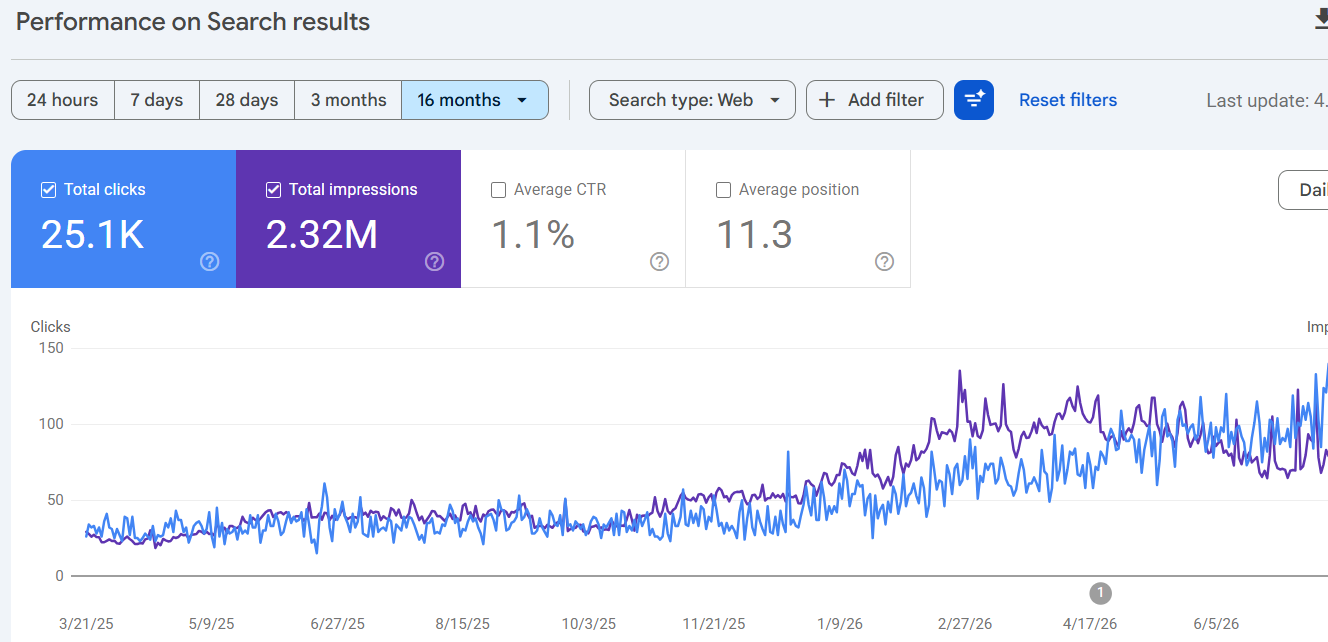 Search Console screenshot
2.32M impressions converted into 25.1K clicks at a 1.1% average CTR, with an average position of 11.3 across all tracked queries. Daily clicks and impressions both climbed from a flat baseline to sustained highs across the 16 month window.
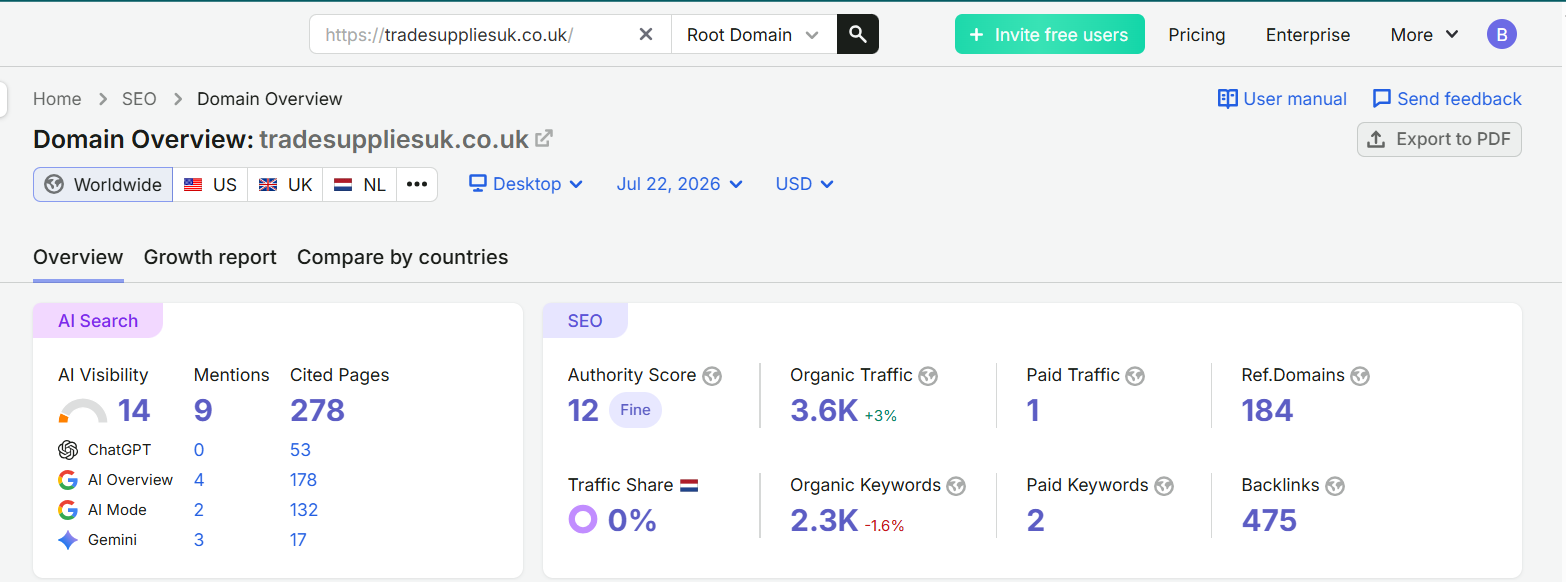 Semrush screenshot
3.6K monthly organic visits, up 3%, drawn from 2.3K ranking keywords. The profile is backed by 475 backlinks across 184 referring domains, with AI visibility at 278 cited pages and 9 mentions.
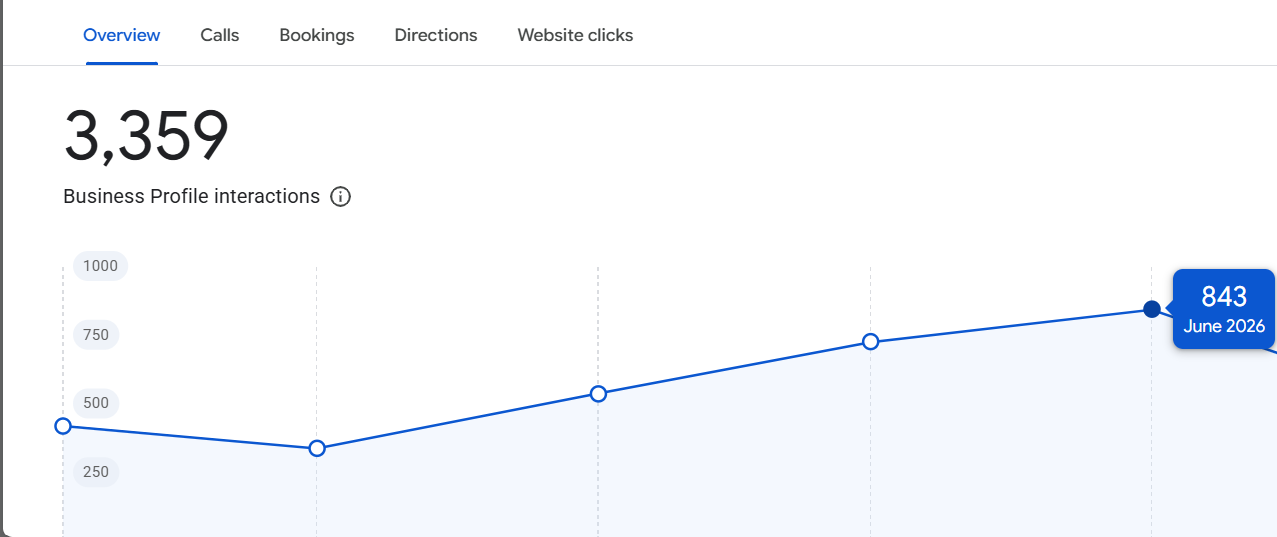 Business Profile screenshot
3,359 Business Profile interactions across the period, climbing from 462 in the opening month to 843 by June 2026. Calls, bookings, direction requests and website clicks all trended upward together after the first quarter.
How we deliver global SEO services
International work is structural before it is anything else. Publishing localised content into a broken market structure is the fastest way to spend a content budget on pages that will never be served to the right country.
- 01
Audit
Every market version crawled, hreflang validated, and Search Console filtered by country to see which version actually ranks where. Phantom markets and same-language duplication show up here, and they are usually the largest finding.
- 02
Decide the model
Subfolders, subdomains or country domains, and which markets genuinely need their own version. Sometimes the recommendation is to consolidate rather than expand, and we would rather say that than build out markets that dilute the ones already working.
- 03
Fix and differentiate
Hreflang corrected, phantom markets removed, canonicals sorted, and the market versions that are staying given enough genuine local difference to justify existing separately.
- 04
Report by market
Monthly reporting split by country rather than as one traffic line. A site-wide number hides a market collapsing while another grows, which is the single most useful thing international reporting can show you.
Within five months our organic traffic had more than tripled, and we were finally showing up on page one for the keywords that actually bring in customers.
SMSarah MitchellOwner, home decor brandWe went from page three to the top of the map pack for our service area in under four months. Calls from search have roughly doubled since.
JCJames CarterOwner, local home services companyThe monthly reporting alone was worth it. For the first time we could see exactly which pages were driving revenue, not just traffic, with organic revenue up 61 percent year over year.
EWEmily WalshMarketing lead, skincare brand
Choosing an international SEO company
International SEO is the work of making a site rank correctly in more than one country or language. It covers market structure, hreflang, cross-market duplication, per-market keyword research and localisation. The distinguishing feature is that most of the problems come from your own pages competing with each other rather than from competitors.
Subfolders are right for most businesses. They inherit the authority of the main domain, so a new market starts from something rather than nothing. Country domains suit businesses with genuine local operations and the resources to build authority separately for each. Subdomains sit in between and are usually chosen for technical reasons rather than SEO ones. The decision is difficult to reverse, which is why it comes first.
Only if you have more than one version of the same page for different countries or languages. If you have one site serving everyone, you do not. Where you do need it, getting it wrong is worse than not having it, because incorrect annotations can cause versions to be filtered from results entirely.
Usually broken or missing hreflang, or near-identical content across markets that leads Google to pick one and ignore the others. Occasionally it is a canonical tag pointing market versions at each other, which tells Google not to index them. The audit distinguishes between these, and the fixes are completely different.
You can, but it will target the wrong keywords. Search behaviour does not translate, and the highest-volume term in one market is often not the direct translation of the highest-volume term in another. Translation gets you a readable page. Local keyword research gets you a page someone finds.
Find out which markets you are losing
Get a free market structure audit covering hreflang errors, phantom markets, cross-market duplication, and which version of your site is actually ranking in each country. Yours to keep either way.