Meta advertising agency for brands that sell in traffic
Creative gets approved, the campaign goes live, and spend disappears with no clear line back to a sale. We build Facebook and Instagram campaigns around what people actually buy from, test creative properly, and fix the tracking so you can tell which ad earned the order.
- Creative tested in a way that tells you why something worked
- Audiences and exclusions structured so campaigns stop competing
- Tracking checked against your back end, not taken on trust
Site health score after technical fixes
What a Facebook ads agency should be doing
Most underperforming Meta accounts have the same three problems, and none of them are the creative. Audiences overlap so campaigns bid against each other. The pixel fires inconsistently, so the numbers in Ads Manager do not match the orders in the back end. And budget is spread thinly enough that nothing exits the learning phase.
- Audience overlap removed first When two ad sets target overlapping audiences, you are competing with yourself and paying a premium for it. Consolidating them usually improves performance without a single new ad being made.
- Tracking reconciled against the back end Ads Manager, GA4 and your platform will each report a different number. We work out where the gap comes from and pick one source as the number decisions are made against, rather than quoting whichever looks best.
- Conversions API set up properly Browser-side pixel data has been degrading for years. Server-side tracking through CAPI recovers a meaningful share of it, with deduplication so events are not counted twice. Most accounts we audit have it half-installed.
- Budget concentrated enough to learn Meta needs a volume of conversions per ad set before its optimisation is doing anything useful. Six ad sets on small budgets will all sit in learning indefinitely. Fewer, better-funded ad sets is usually the fix.
Keywords ranking across the site
Instagram ads management services that convert
Instagram and Facebook run from the same Ads Manager, which makes it easy to treat them as one placement and let the algorithm decide. That works until it does not. The two platforms have different audiences, different formats and different expectations of what an ad should look like, and the same asset rarely performs equally on both.
- Placements reported separately. Automatic placements are usually the right starting point, but you need to see the split. An account where Instagram carries most of the purchases and Facebook most of the spend is a common finding, and it is invisible in a combined report.
- Creative built for the format. Pillar pages supported by properly linked subtopics, building depth around the themes you want to be known for.
- Reels and Stories treated as their own thing These placements have their own creative rules and their own cost structures. Where they perform, they often perform considerably better than feed. Where they do not, excluding them stops the leak.
- Age and audience narrowed on evidence. Broad targeting is the sensible default, but reporting will eventually show where the purchases concentrate. Narrowing at that point, on data rather than assumption, is where a lot of accounts find their next step.
Backlinks from 184 referring domains
Creative is the campaign not the wrapper
On search, someone tells you what they want and you compete on relevance and bid. On Meta, nobody asked. The creative has to earn the attention before anything else matters, which is why two accounts with identical settings and different creative produce completely different results. Targeting has become simpler over the years. Creative has become the whole job.
- Concepts tested, not just variations Changing a headline tells you very little. Testing a genuinely different angle, a different hook, a different format, tells you what your audience responds to. Then the winner gets iterated, which is where volume of variations actually earns its place.
- The first three seconds do the work Most of the drop-off happens before the message arrives. We build hooks deliberately and test them against each other, because a strong offer behind a weak opening never gets seen.
- UGC-style where it suits the brand Ads that look like content outperform ads that look like ads in most feeds. That does not mean every brand should abandon polish, and we will say when it does not suit you rather than producing it by default.
- Winners documented, not just repeated When something works we record why we think it worked, so the next round starts from a hypothesis rather than from scratch. Over months that record is worth more than any single winning ad.
How our Meta ads agency runs an account
Paid social produces data quickly, but it needs a fair test window before the numbers mean anything. We structure the first month around learning what works rather than around hitting a target that has not been calibrated yet.
- 01
Audit
Account structure, audience overlap, tracking accuracy and creative history reviewed. We reconcile what Ads Manager reports against your actual orders, which is where most of the surprises are.
- 02
Rebuild and test
Structure simplified, tracking fixed, and a first round of creative concepts built to test angles rather than variations. Budget concentrated enough for ad sets to exit learning.
- 03
Iterate on winners
Whatever wins gets iterated into more versions, and whatever loses gets documented so the next round is not a repeat. This is the loop that compounds over months.
- 04
Report on revenue
Monthly reporting on spend, purchases, cost per purchase and return on ad spend, reconciled against your back end. Creative-level breakdown included, so you can see which ads carried the result rather than only the account total.
Every claim here comes with the dashboard behind it
Search visibility, domain authority and local presence, pulled straight from the reporting we send clients each month. Click any screenshot to see the raw data for yourself.
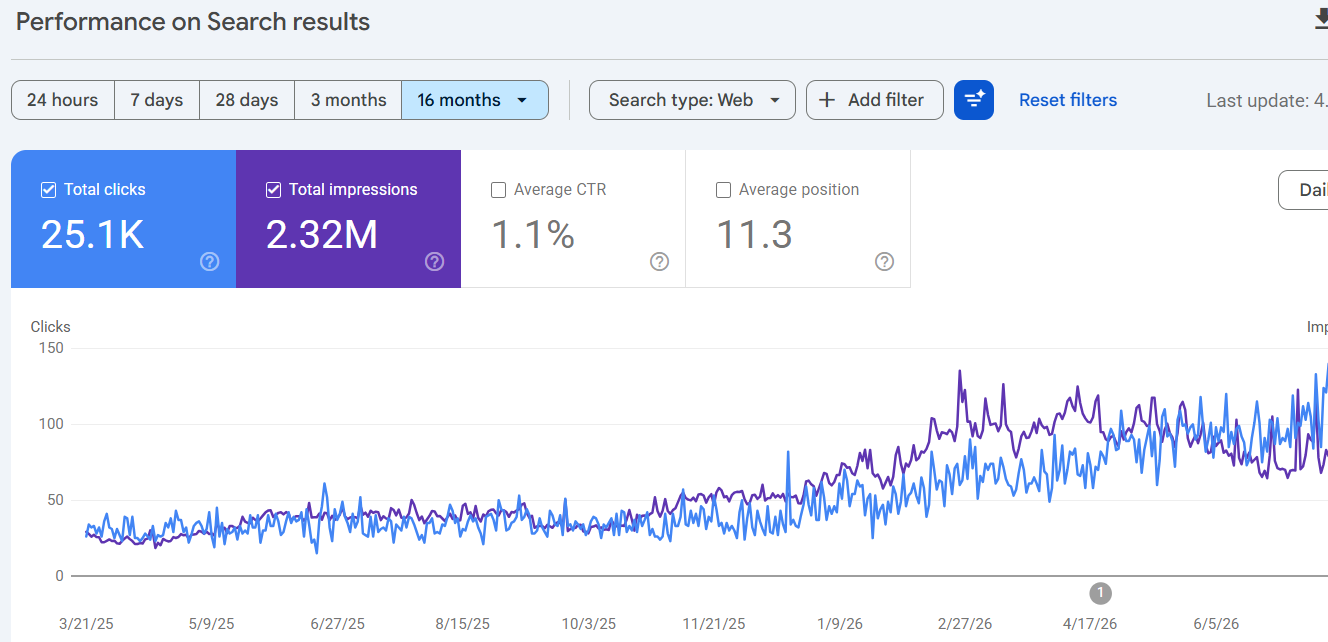 Search Console screenshot
2.32M impressions converted into 25.1K clicks at a 1.1% average CTR, with an average position of 11.3 across all tracked queries. Daily clicks and impressions both climbed from a flat baseline to sustained highs across the 16 month window.
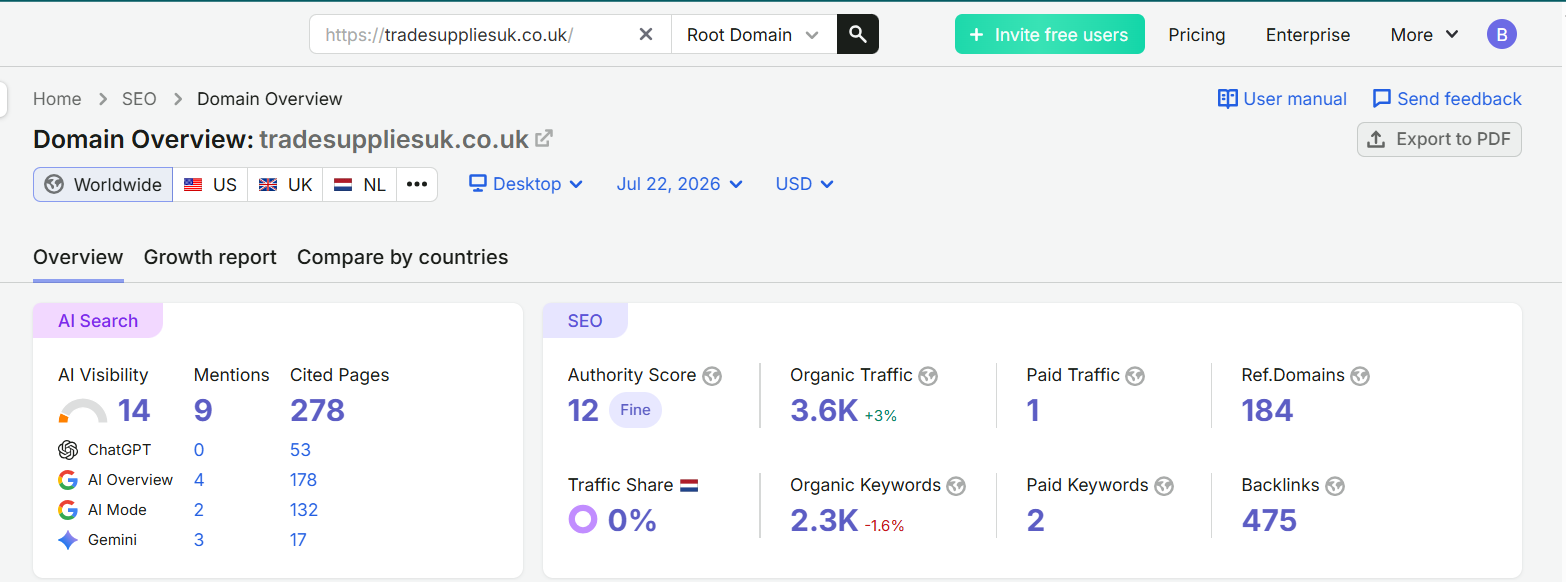 Semrush screenshot
3.6K monthly organic visits, up 3%, drawn from 2.3K ranking keywords. The profile is backed by 475 backlinks across 184 referring domains, with AI visibility at 278 cited pages and 9 mentions.
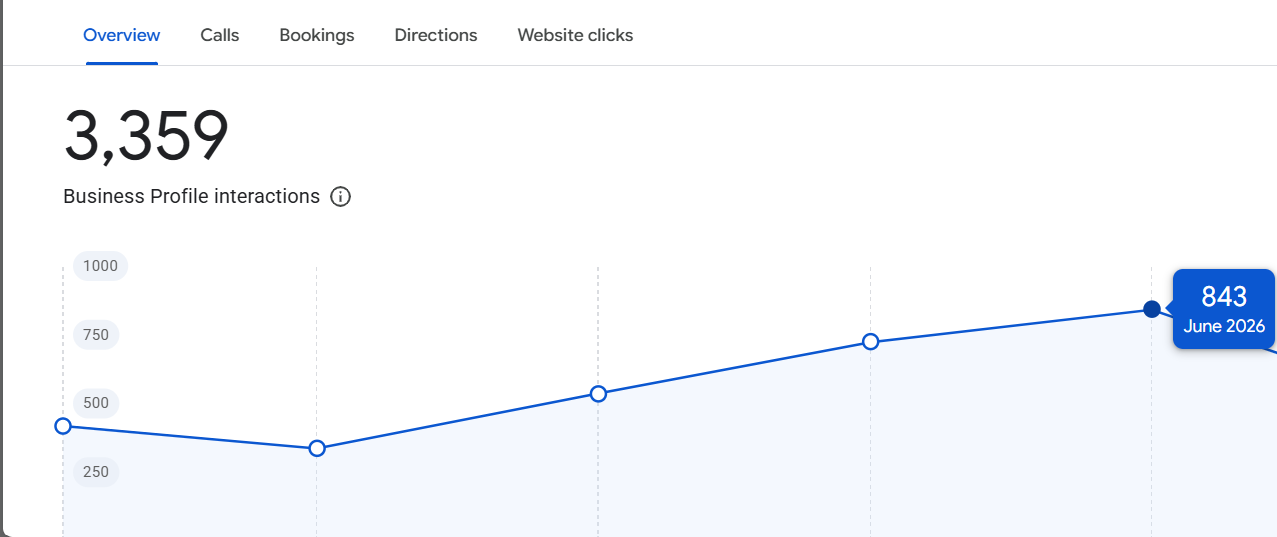 Business Profile screenshot
3,359 Business Profile interactions across the period, climbing from 462 in the opening month to 843 by June 2026. Calls, bookings, direction requests and website clicks all trended upward together after the first quarter.
Within five months our organic traffic had more than tripled, and we were finally showing up on page one for the keywords that actually bring in customers.
SMSarah MitchellOwner, home decor brandWe went from page three to the top of the map pack for our service area in under four months. Calls from search have roughly doubled since.
JCJames CarterOwner, local home services companyThe monthly reporting alone was worth it. For the first time we could see exactly which pages were driving revenue, not just traffic, with organic revenue up 61 percent year over year.
EWEmily WalshMarketing lead, skincare brand
Meta ads questions we get asked most
Meta advertising is paid promotion across Facebook and Instagram, run through the same Ads Manager. It covers campaign structure, audience targeting, creative and conversion tracking. The main difference from search advertising is that nobody searched for you, so the creative has to earn the attention before the offer matters.
Yes. We run SEO for service businesses, local brands and online stores alike. Your strategy is built around your industry, not a one-size-fits-all template.
Usually creative fatigue. The same audience has seen the same ad enough times that response drops, and no amount of bid or budget adjustment fixes it. Sometimes it is tracking degrading quietly, or an audience that has been exhausted. The audit distinguishes between them, because the fixes are completely different.
We can do either. Most clients find it works best when we produce, because the testing loop moves faster when the people reading the results are the people making the next round. Where you have an in-house team we brief them instead and work from what the data says.
Run both and let the reporting answer it. Automatic placements let Meta find where your audience responds, and the split usually becomes clear within a few weeks. Deciding upfront tends to be based on where the business owner spends their own time, which is rarely where their customers are.
Find out why your ads stopped working
Get a free ad account audit covering campaign structure, audience overlap, tracking accuracy against your back end, and an honest read on whether the problem is creative fatigue or something else. Yours to keep either way.